
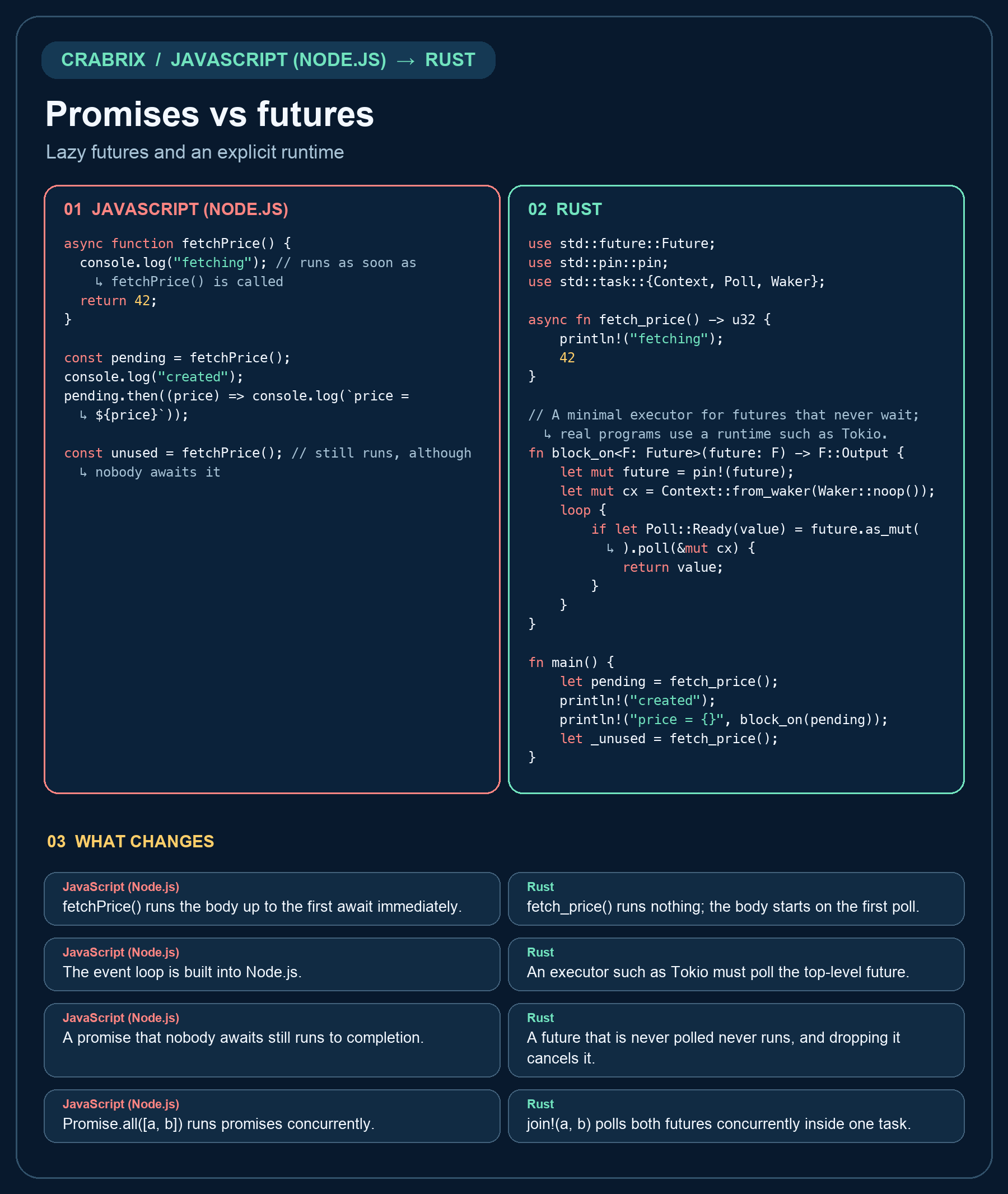
JavaScript (Node.js) and Rust, side by side
fetching prints twice even though one promise is never used.async function fetchPrice() {
console.log("fetching"); // runs as soon as fetchPrice() is called
return 42;
}
const pending = fetchPrice();
console.log("created");
pending.then((price) => console.log(`price = ${price}`));
const unused = fetchPrice(); // still runs, although nobody awaits itcreated prints before fetching: the future runs only when block_on polls it, and the unused one never runs.use std::future::Future;
use std::pin::pin;
use std::task::{Context, Poll, Waker};
async fn fetch_price() -> u32 {
println!("fetching");
42
}
// A minimal executor for futures that never wait; real programs use a runtime such as Tokio.
fn block_on<F: Future>(future: F) -> F::Output {
let mut future = pin!(future);
let mut cx = Context::from_waker(Waker::noop());
loop {
if let Poll::Ready(value) = future.as_mut().poll(&mut cx) {
return value;
}
}
}
fn main() {
let pending = fetch_price();
println!("created");
println!("price = {}", block_on(pending));
let _unused = fetch_price();
}| JavaScript (Node.js) | Rust |
|---|---|
fetchPrice() runs the body up to the first await immediately. | fetch_price() runs nothing; the body starts on the first poll. |
| The event loop is built into Node.js. | An executor such as Tokio must poll the top-level future. |
| A promise that nobody awaits still runs to completion. | A future that is never polled never runs, and dropping it cancels it. |
Promise.all([a, b]) runs promises concurrently. | join!(a, b) polls both futures concurrently inside one task. |
Understand it
Calling an async function in JavaScript runs its body synchronously up to the first await, and the event loop keeps the rest going. That is why the example prints fetching before created, and why the unused second call still logs. Calling a Rust async fn runs nothing: it returns a value that implements Future, a state machine waiting to be polled. Only polling, normally through .await, executes the body.
Rust has no built-in event loop. Something must poll the top-level future: an executor such as the Tokio runtime behind #[tokio::main], or, in this example, a ten-line block_on that polls in a loop. That block_on only suits futures that never wait on I/O; a real runtime parks the thread and uses the Waker to resume work when a socket or timer is ready. .await itself is only allowed inside async functions and blocks (E0728).
Laziness has consequences you can use. A future that is dropped before it completes simply stops, which is how timeouts and select! cancel work, whereas a JavaScript promise cannot be cancelled from outside; there is only an AbortSignal the callee may honour. Writing let pending = fetch_price(); and awaiting it later starts nothing early. To run several futures concurrently, combine them with join! or spawn them as tasks, the counterparts of Promise.all and of starting promises without awaiting them.
rustc helps with the most common mistake. A future that is created and never used triggers the unused_must_use warning, unused implementer of Future that must be used. Treat that warning as an error in async code; it almost always means a missing .await.
The JavaScript (Node.js) habit, written in Rust
This is how the JavaScript (Node.js) version usually looks on a first attempt in Rust. Predict what rustc says before you read the explanation.
async fn save(record: &str) {
    println!("saved {record}");
}

fn main() {
    save("invoice-7");
    println!("done");
}Try it
Predict the output of the example, then move println!("created") after the block_on call and predict again. Finally replace let _unused = fetch_price(); with fetch_price(); and read the warning.
What success looks like: Your predictions match the program: created before fetching, and the unused future never prints.
Check your understanding
What does the practice program print?
Reveal the answer
saved invoice-7thendone, like calling an async function in Node.js- Only
done: the future returned bysaveis never polled - Nothing: rustc rejects calling an
async fnwithout.await
The call creates a future and drops it at the end of the statement. rustc warns that it must be used, but the program builds and prints only done.
Go deeper
Common misconception: “Calling an async fn starts it in the background, like calling an async function in Node.js.”
Calling an async fn only builds a future. Nothing runs until it is polled, normally by .await inside a runtime.
- Create the future:
let pending = fetch_price();stores a future. No line insidefetch_pricehas run yet. - Poll it:
block_on(pending)polls once. The body printsfetchingand returns42without waiting, so the first poll is alreadyReady. - Compare with evidence: Run it:
created,fetching,price = 42. The_unusedfuture is dropped at the end ofmainwithout printing anything.
Transfer challenge: Write async fn total() -> u32 that awaits fetch_price() twice and adds the results. Run it with block_on and predict how many times fetching prints, then compare with a JavaScript version that uses Promise.all.
Connections
- npm and package.json vs Cargo: package.json and npm mapped to Cargo
- Futures: async fn, await, and laziness
Learn this lesson with AI
Paste this into Claude, Codex, Cursor or another agent connected to Crabrix Academy. It contains only this lesson’s public details.
I'm learning Rust with Crabrix Academy. Teach me this lesson with the Crabrix Academy tools.
Lesson: Promises vs futures (courseId "rust-for-nodejs-developers", lessonId "node-promises-to-futures")
Link: https://crabrix.com/learn/rust-for-nodejs-developers/node-promises-to-futures/
Goal: Futures are lazy: calling an async fn only creates a future, and no code inside it runs until something polls it.
Practice: open the starter in the Crabrix Playground (https://crabrix.com/playground/?lesson=rust-for-nodejs-developers/node-promises-to-futures) and I will write the code there.
Explain it step by step for my level, let me write the code myself, give hints before any solution, and do not mark anything as passed: only Crabrix checks do that.