

Understand it
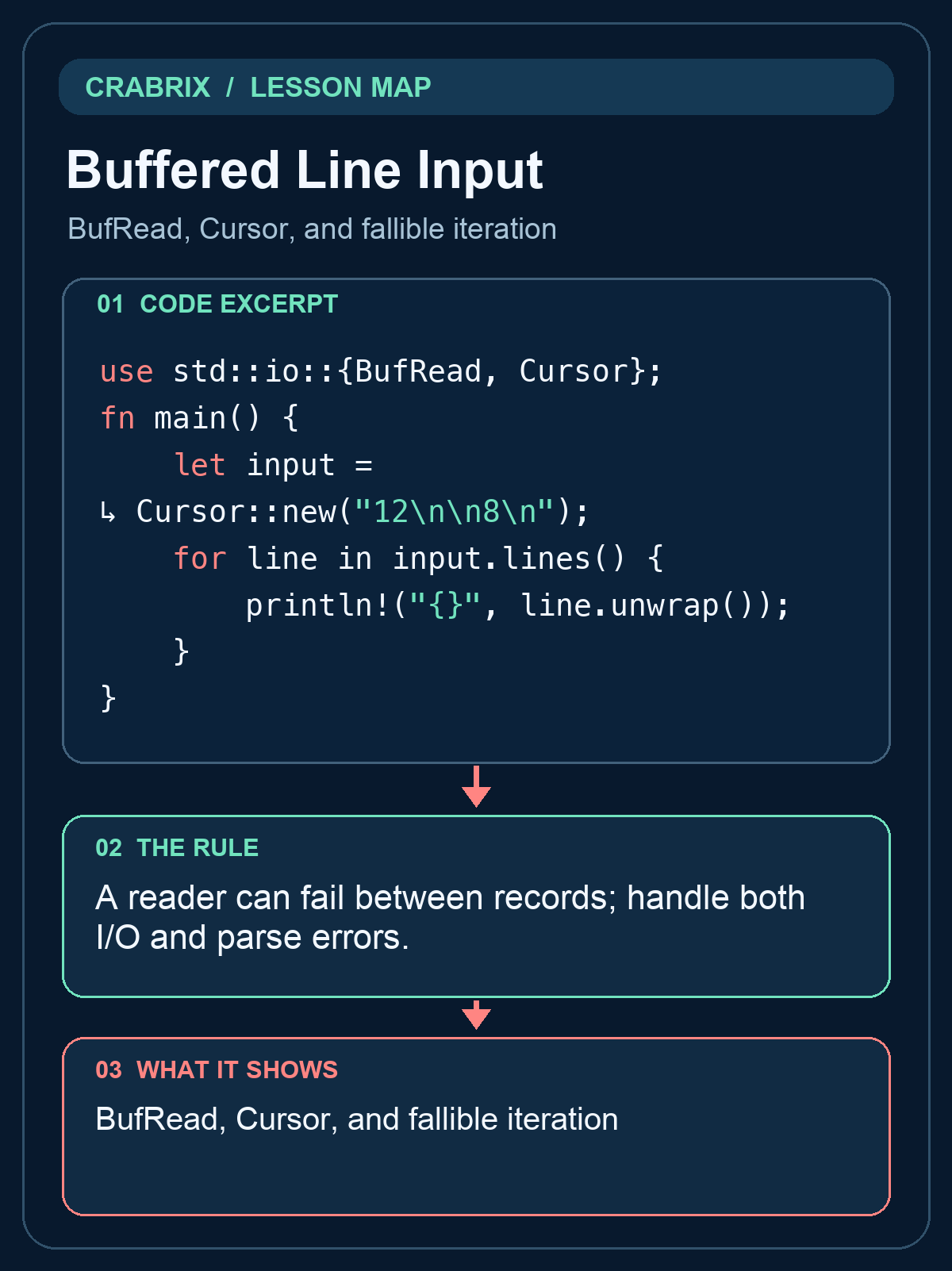
A file is a source of bytes, not a ready-made collection of valid records. Give the parser a generic R: BufRead input so the same function can accept a buffered file, locked stdin, or an in-memory Cursor. This separates the data transformation from permissions, paths, and device-specific I/O. It also makes the parser easy to exercise without creating a real file.
The lines() iterator yields io::Result<String> values. First handle the read result, then decide what a line means. For this small report, trim whitespace, skip blank lines, and parse every other line as i64. A malformed nonblank line is an error, not a zero and not a reason to silently discard the record. Include the one-based physical line number in that error, even when earlier lines were blank.
Use checked_add when the accepted numeric domain can overflow the accumulator. Returning a clear error preserves the contract instead of making behavior depend on a debug or release overflow setting. Streaming avoids retaining every record, but one unusually long line can still allocate a large string. A production parser needs a separate record-size limit; buffering alone is not a memory quota.
Local compiler profile: standard library only. The lab uses Cursor and needs no filesystem permission, package download, network request, or backend execution. Once the parser is correct, a desktop adapter can pass BufReader::new(File::open(path)?). In Crabrix, an adapter must use files granted to its sandbox. Keep the transformation independently testable before adding that adapter.
Read the code
use std::io::{BufRead, Cursor};
fn main() {
    let input = Cursor::new("12\n\n8\n");
    for line in input.lines() {
        println!("{}", line.unwrap());
    }
}
BufRead, Cursor, and fallible iteration
Try it
Implement total(reader): skip blank lines, sum trimmed i64 records with checked_add, return line N for the first malformed physical line, overflow for arithmetic overflow, and read failed for an I/O failure. In the Crabrix app, open the compiler lab and complete the supplied function in solution.rs. The reading question is a separate exercise.
What success looks like: The local compiler accepts the changed solution and the separate verification harness finishes all normal and boundary cases. Printing a success message alone does not complete this lab.
Check your understanding
Why can filter_map(Result::ok) silently corrupt this report?
Reveal the answer
- It turns every successful line into bytes
- It drops read failures instead of reporting incomplete input
- It forces all numbers to zero
Dropping errors can produce a believable total from only part of the input. Propagate read failures and identify malformed records.
Go deeper
Common misconception: A buffered reader has already validated every record.
Buffering changes how bytes are read; parsing and error policy are separate.
- Read: Unwrap each fallible line before parsing its contents.
- Validate: Track the physical line number and reject invalid integers.
- Accumulate: Add with overflow detection and return one result.
Transfer challenge: Replace Cursor with a deliberately failing Read implementation. Confirm the report returns an error rather than a partial total.
Connections
- Paths & Boundaries: Path, PathBuf, and lexical validation