
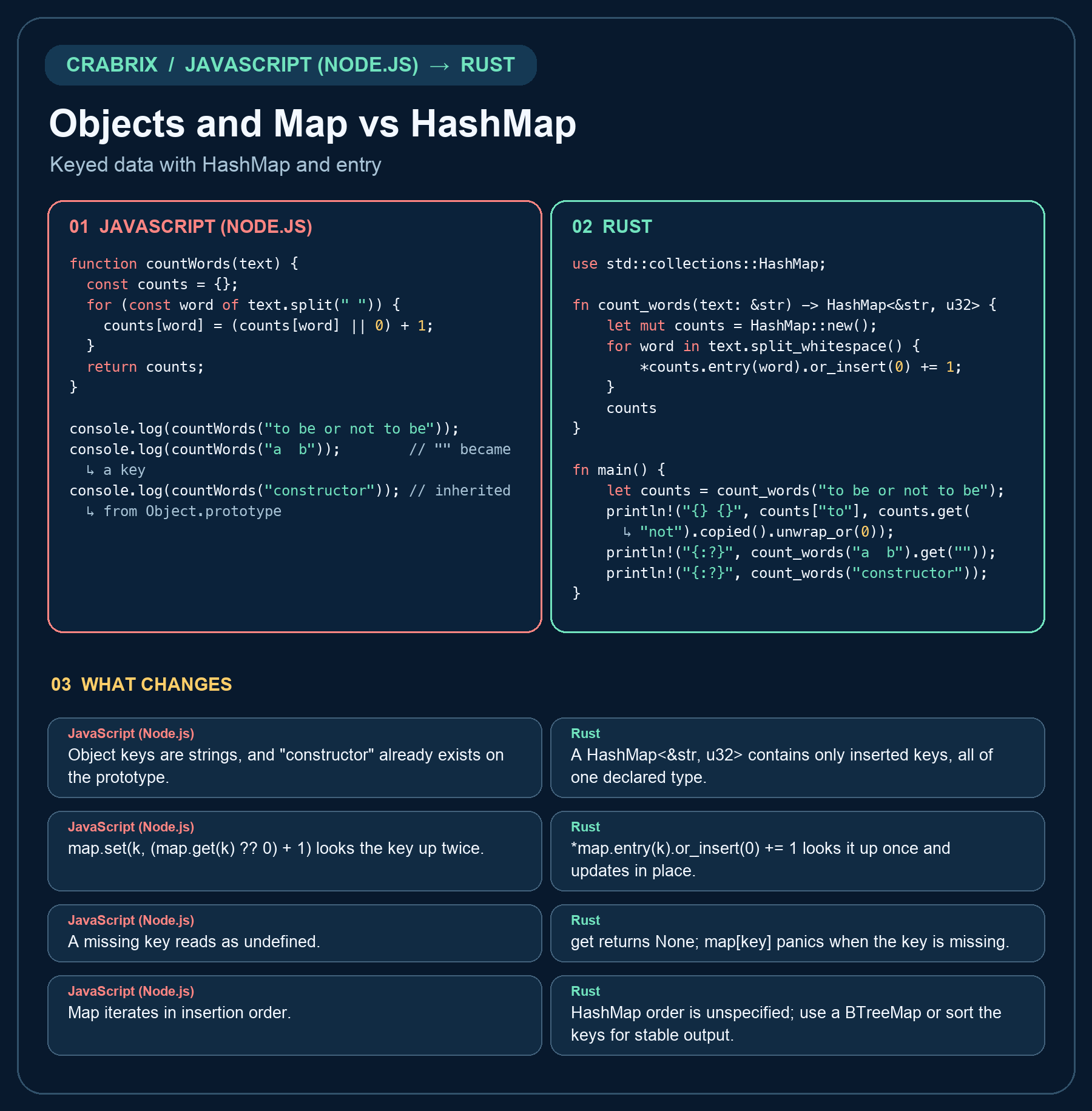
JavaScript (Node.js) and Rust, side by side
"" becomes a key, and constructor collides with Object.prototype.function countWords(text) {
const counts = {};
for (const word of text.split(" ")) {
counts[word] = (counts[word] || 0) + 1;
}
return counts;
}
console.log(countWords("to be or not to be"));
console.log(countWords("a b")); // "" became a key
console.log(countWords("constructor")); // inherited from Object.prototypesplit_whitespace drops empty words, entry updates in one lookup, and constructor is just another key.use std::collections::HashMap;
fn count_words(text: &str) -> HashMap<&str, u32> {
let mut counts = HashMap::new();
for word in text.split_whitespace() {
*counts.entry(word).or_insert(0) += 1;
}
counts
}
fn main() {
let counts = count_words("to be or not to be");
println!("{} {}", counts["to"], counts.get("not").copied().unwrap_or(0));
println!("{:?}", count_words("a b").get(""));
println!("{:?}", count_words("constructor"));
}| JavaScript (Node.js) | Rust |
|---|---|
Object keys are strings, and "constructor" already exists on the prototype. | A HashMap<&str, u32> contains only inserted keys, all of one declared type. |
map.set(k, (map.get(k) ?? 0) + 1) looks the key up twice. | *map.entry(k).or_insert(0) += 1 looks it up once and updates in place. |
A missing key reads as undefined. | get returns None; map[key] panics when the key is missing. |
Map iterates in insertion order. | HashMap order is unspecified; use a BTreeMap or sort the keys for stable output. |
Understand it
Objects make convenient dictionaries until a key collides with the prototype. In the JavaScript example, counts["constructor"] finds Object.prototype.constructor, so (counts[word] || 0) + 1 produces "function Object() { [native code] }1". Keys are also converted to strings, so 1 and "1" are the same key. Map fixes both problems, and HashMap<K, V> is its Rust counterpart: keys and values have declared types, and only inserted keys exist.
The counting idiom becomes the entry API. counts.entry(word) looks the key up once and returns an Entry; or_insert(0) inserts the default if the slot was vacant and returns &mut u32 in both cases, so *... += 1 updates in place. get followed by insert does two lookups, and insert alone overwrites like Map.set, which is the classic bug when porting totals.set(k, (totals.get(k) ?? 0) + v).
Reading is explicit about absence. counts.get("be") returns an Option<&u32>. counts["be"] also compiles, but it panics when the key is missing instead of returning undefined, so use indexing only for keys you know are present.
Iteration order is not insertion order. A Map preserves insertion order; a HashMap uses a randomly seeded hasher, so its order can differ between runs. Sort the keys, or use a BTreeMap for key order, when output must be stable. Splitting text differs too: split(' ') keeps the empty strings between double spaces in both languages, while split_whitespace() skips them.
The JavaScript (Node.js) habit, written in Rust
This is how the JavaScript (Node.js) version usually looks on a first attempt in Rust. Predict what rustc says before you read the explanation.
use std::collections::HashMap;

fn main() {
    let mut counts: HashMap<&str, u32> = HashMap::new();
    counts.insert("to", 2);
    let be = counts["be"];
    println!("{be}");
}Try it
Port the JavaScript totalsByCustomer shown at the top of solution.rs. Add each order's cents to its customer's total, using entry for the update, and return the map. Keys are case-sensitive. In the Crabrix app, open the compiler lab and complete the supplied function in solution.rs. The reading question is a separate exercise.
What success looks like: The local compiler accepts the changed solution and the separate verification harness passes every case, including repeated customers, an empty list and a constructor key. Printing a success message alone does not complete this lab.
Check your understanding
Why is *counts.entry(word).or_insert(0) += 1 preferred over get followed by insert?
Reveal the answer
- It keeps the keys sorted
- It avoids allocating the key
- It looks the key up once and returns a mutable reference whether or not the entry existed
or_insert returns &mut V for both the vacant and the occupied case, so one lookup covers the update.
Go deeper
Common misconception: “insert adds to the existing value, the way the JavaScript counting line does.”
insert replaces the old value and returns it as an Option<V>, like Map.set. Use entry(key).or_insert(0) and add through the returned &mut V.
- Read the key type:
count_wordsreturnsHashMap<&str, u32>: the keys borrow slices oftext, so noStringis allocated per word. - Follow one update: For the second
"to",entryfinds the occupied slot,or_insert(0)returns a&mut u32holding 1, and+= 1makes it 2. - Compare with evidence: Run it:
2 1,Nonefor the empty key, and{"constructor": 1}. Replacesplit_whitespace()withsplit(' ')andget("")returnsSome(1)for"a b".
Transfer challenge: Make count_words return a BTreeMap and print the whole map for "to be or not to be". Then explain why the HashMap version might print the same pairs in a different order on another run.
Connections
- Array methods vs iterators: Lazy iterator pipelines
- UTF-16 strings vs UTF-8 String: UTF-8 bytes, chars and lengths
Learn this lesson with AI
Paste this into Claude, Codex, Cursor or another agent connected to Crabrix Academy. It contains only this lesson’s public details.
I'm learning Rust with Crabrix Academy. Teach me this lesson with the Crabrix Academy tools.
Lesson: Objects and Map vs HashMap (courseId "rust-for-nodejs-developers", lessonId "node-map-and-objects-to-hashmap")
Link: https://crabrix.com/learn/rust-for-nodejs-developers/node-map-and-objects-to-hashmap/
Goal: entry(key).or_insert(default) looks the key up once and returns a mutable reference to the value, whether or not it was already there.
Practice: open the starter in the Crabrix Playground (https://crabrix.com/playground/?lesson=rust-for-nodejs-developers/node-map-and-objects-to-hashmap) and I will write the code there.
Explain it step by step for my level, let me write the code myself, give hints before any solution, and do not mark anything as passed: only Crabrix checks do that.