
JavaScript (Node.js) and Rust, side by side
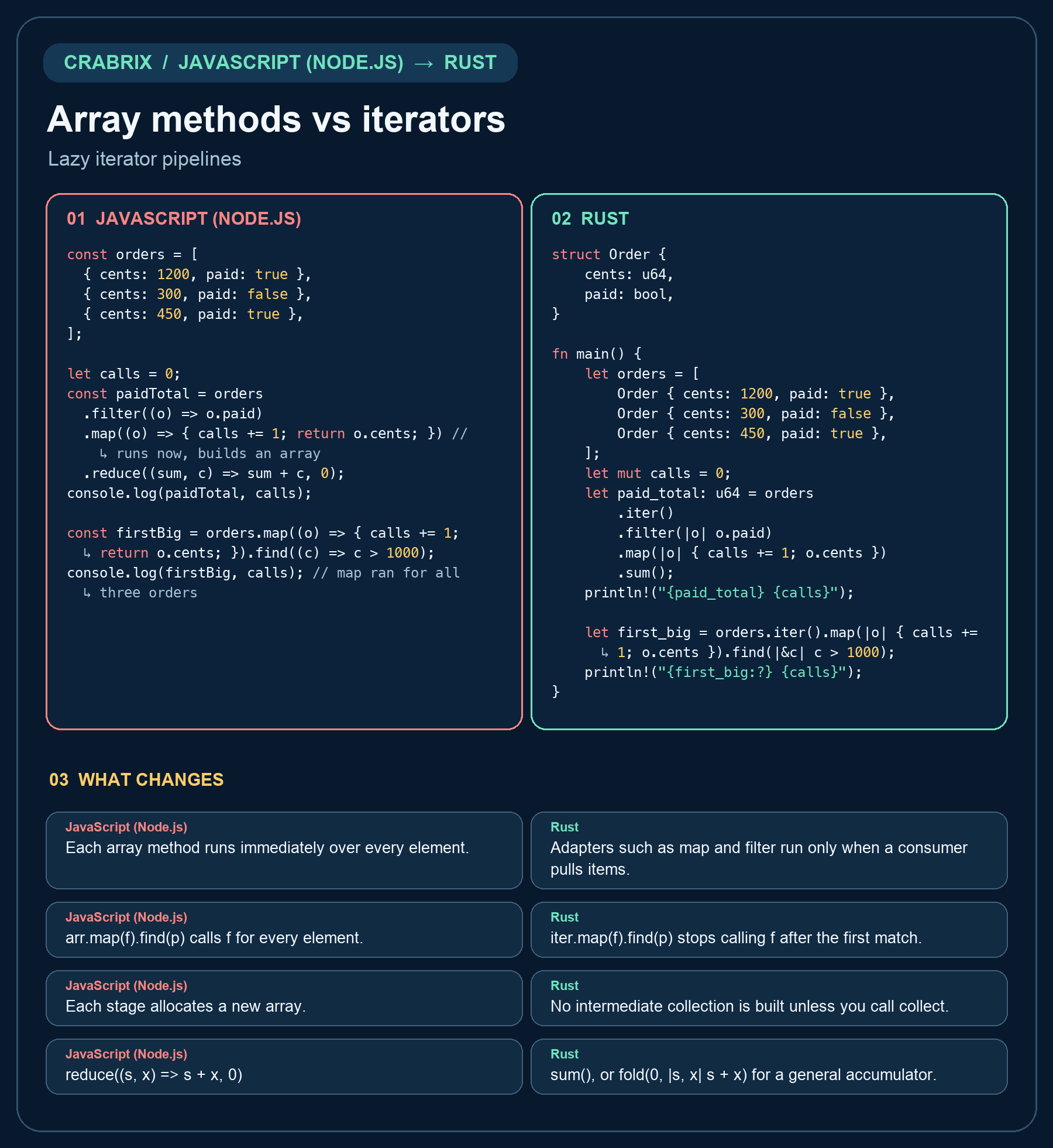
map runs eagerly, so the search for the first big order still maps all three orders.const orders = [
{ cents: 1200, paid: true },
{ cents: 300, paid: false },
{ cents: 450, paid: true },
];
let calls = 0;
const paidTotal = orders
.filter((o) => o.paid)
.map((o) => { calls += 1; return o.cents; }) // runs now, builds an array
.reduce((sum, c) => sum + c, 0);
console.log(paidTotal, calls);
const firstBig = orders.map((o) => { calls += 1; return o.cents; }).find((c) => c > 1000);
console.log(firstBig, calls); // map ran for all three ordersstruct Order {
cents: u64,
paid: bool,
}
fn main() {
let orders = [
Order { cents: 1200, paid: true },
Order { cents: 300, paid: false },
Order { cents: 450, paid: true },
];
let mut calls = 0;
let paid_total: u64 = orders
.iter()
.filter(|o| o.paid)
.map(|o| { calls += 1; o.cents })
.sum();
println!("{paid_total} {calls}");
let first_big = orders.iter().map(|o| { calls += 1; o.cents }).find(|&c| c > 1000);
println!("{first_big:?} {calls}");
}| JavaScript (Node.js) | Rust |
|---|---|
| Each array method runs immediately over every element. | Adapters such as map and filter run only when a consumer pulls items. |
arr.map(f).find(p) calls f for every element. | iter.map(f).find(p) stops calling f after the first match. |
| Each stage allocates a new array. | No intermediate collection is built unless you call collect. |
reduce((s, x) => s + x, 0) | sum(), or fold(0, |s, x| s + x) for a general accumulator. |
Understand it
orders.filter(...).map(...).reduce(...) runs each stage over the whole array and allocates an intermediate array between stages. Rust's orders.iter().filter(...).map(...).sum() first builds a description of the work. Nothing happens until sum asks for the first item; then each order flows through filter and map one at a time, with no intermediate Vec.
Laziness changes what runs. In the JavaScript example, map(...).find(...) calls the mapping function for all three orders before find looks at one. The Rust pipeline stops at the first match, so its closure runs once. A pipeline that is never consumed does nothing at all, which is why rustc warns that an unused Map must be used in the practice code.
The names mostly carry over: map, filter and find are the same, some is any, every is all, reduce with an initial value is fold, and flatMap is flat_map. The length of a filtered result is count(), and collect::<Vec<_>>() gives you a collection back. There is no index argument; add .enumerate() to get (index, item) pairs.
Watch what the iterator yields. iter() yields references (&Order), iter_mut() yields &mut Order, and into_iter() on a Vec yields owned values and consumes the vector. That is why the closures read o.cents through a reference, and why find(|&c| c > 1000) destructures the &u64 it receives.
The JavaScript (Node.js) habit, written in Rust
This is how the JavaScript (Node.js) version usually looks on a first attempt in Rust. Predict what rustc says before you read the explanation.
fn main() {
    let prices = vec![3, 7, 12];
    prices.iter().map(|p| {
        println!("checking {p}");
        p * 2
    });
    println!("done");
}Try it
Port the JavaScript firstPriceOver shown at the top of solution.rs, but keep the Rust version lazy: call price_of only until the first price above limit is found. The harness counts the calls. In the Crabrix app, open the compiler lab and complete the supplied function in solution.rs. The reading question is a separate exercise.
What success looks like: The local compiler accepts the changed solution and the separate verification harness passes every case, including the number of price_of calls and an empty slice. Printing a success message alone does not complete this lab.
Check your understanding
In the practice code, what has map done by the time done prints?
Reveal the answer
- Nothing: no consumer such as
sum,collectorforasked for a value - It doubled all three prices into a new vector, like
Array.prototype.map - It doubled the first price and then paused
An adapter only describes work. Without a consumer the closure never runs, and rustc warns that the Map must be used.
Go deeper
Common misconception: “iter().map(...) works like Array.prototype.map: it builds the new values right away.”
map returns a lazy adapter. The closure runs only when a consumer pulls an item, and only for the items it pulls.
- Read the pipeline:
orders.iter()yields&Order.filterkeeps the paid orders,mapturns each into its cents, andsumis the only consumer. - Count the work:
sumpulls items one at a time. Only the two paid orders reachmap, socallsbecomes 2; the unpaid order never does. - Compare with evidence: Run it:
1650 2, thenSome(1200) 3.findstopped after the first order, while JavaScript'smaphad already run for all three.
Transfer challenge: Insert .inspect(|o| println!("saw {}", o.cents)) right after orders.iter() in both pipelines and predict the printed lines. Then add .collect::<Vec<_>>() after the second map, iterate that vector for the find, and count the calls again.
Connections
- null, undefined and ?? vs Option: Absence as Option<T>
- Objects and Map vs HashMap: Keyed data with HashMap and entry
Learn this lesson with AI
Paste this into Claude, Codex, Cursor or another agent connected to Crabrix Academy. It contains only this lesson’s public details.
I'm learning Rust with Crabrix Academy. Teach me this lesson with the Crabrix Academy tools.
Lesson: Array methods vs iterators (courseId "rust-for-nodejs-developers", lessonId "node-array-methods-to-iterators")
Link: https://crabrix.com/learn/rust-for-nodejs-developers/node-array-methods-to-iterators/
Goal: Iterator adapters are lazy: a consumer such as sum, find, collect or a for loop drives the work, one item at a time.
Practice: open the starter in the Crabrix Playground (https://crabrix.com/playground/?lesson=rust-for-nodejs-developers/node-array-methods-to-iterators) and I will write the code there.
Explain it step by step for my level, let me write the code myself, give hints before any solution, and do not mark anything as passed: only Crabrix checks do that.