

Understand it
An HTTP method is part of the request contract. GET /tasks lists tasks; POST /tasks creates one. A known resource with a disallowed method is different from a path the application does not own. This lab returns 405 for unsupported methods on /tasks and 404 for unknown paths; GET /health returns 200, while other health methods return 405.
The request target can include a query string. Separate it before matching the path, but do not lowercase the path or decode arbitrary escapes without a policy: route names can be case sensitive. The lab implements literal paths only. A desktop Axum router handles the transport; the on-device adapter passes a bounded real HTTP request to Rust through stdin. It is an HTTP/1.x adapter with one response per connection, not an implementation of every HTTP version or chunked body mode.
The route project is Task Ledger: first keep a reproducible source history, then expose its data through a CLI and HTTP boundary, persist it in SQL, diagnose failures and prepare a release. This lesson owns one contract in that project. Run the worked example before changing the starter and explain which input makes the tempting shortcut fail.
Terminal practice: Run cargo serve --port 8080 --database tasks.db, then curl -i http://127.0.0.1:8080/tasks and curl -i -X DELETE http://127.0.0.1:8080/tasks. Stop with http stop.
The compiler lab is independent of the reading question. Edit solution.rs; the app supplies a separate caller with normal, empty and adversarial inputs. A successful unchanged demonstration does not prove your implementation. After the lab, apply the same contract to the route companion project. Its README separates the on-device adapter from the desktop Cargo/TCP profile.
Read the code
pub fn route(method: &str, target: &str) -> u16 {
    match target.split('?').next().unwrap_or("") {
        "/tasks" => match method {
            "GET" => 200,
            "POST" => 201,
            _ => 405,
        },
        "/health" => {
            if method == "GET" {
                200
            } else {
                405
            }
        }
        _ => 404,
    }
}

fn main() {
    assert_eq!(route("GET", "/tasks?limit=5"), 200, "case 1");
    assert_eq!(route("GET", "/missing"), 404, "case 2");
    assert_eq!(route("DELETE", "/tasks"), 405, "case 3");
    assert_eq!(route("POST", "/tasks"), 201, "case 4");
    assert_eq!(route("GET", "/Tasks"), 404, "case 5");
    assert_eq!(route("POST", "/health"), 405, "case 6");
    println!("worked example passed");
}
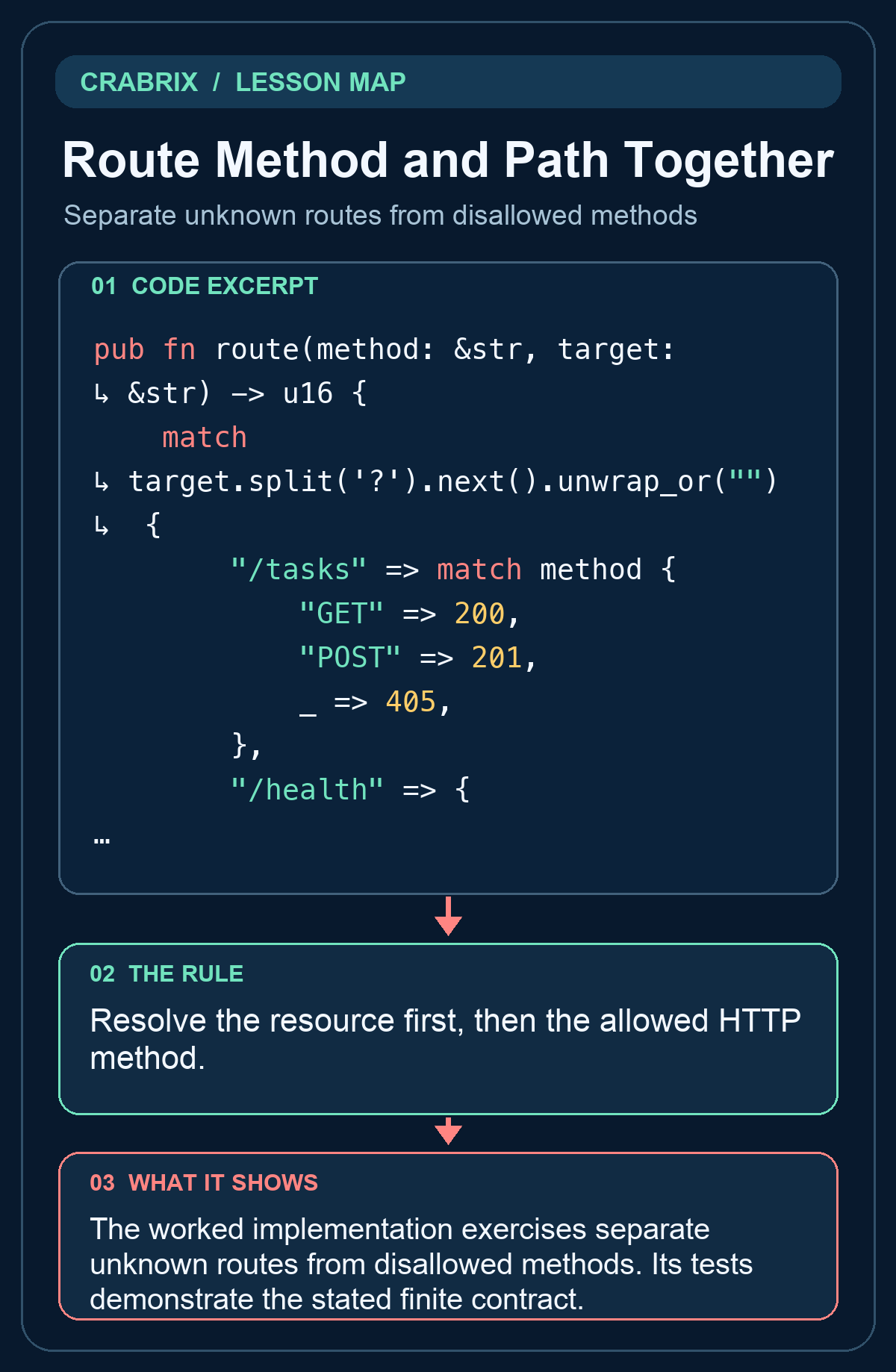
The worked implementation exercises separate unknown routes from disallowed methods. Its tests demonstrate the stated finite contract.
Practice starter
pub fn route(method: &str, target: &str) -> u16 {
    todo!("implement the contract")
}
Try it
Match literal /tasks and /health after removing the query string. GET tasks=200, POST tasks=201, GET health=200; other methods on those paths=405, unknown paths=404. Keep the public signature. Open the compiler lab and edit solution.rs; do not edit the private verification caller.
What success looks like: The separate caller accepts the changed solution and rejects unchanged TODO, a wrong implementation and a printed success message.
Check your understanding
What distinguishes 405 from 404 in this routing contract?
Reveal the answer
- Both statuses always mean the same thing
- An unknown path should return 200 with an empty body
- The resource exists but the method is disallowed
Matching only a method or only a path loses the distinction between unsupported operations and unknown resources.
Go deeper
Common misconception: Both statuses always mean the same thing
Resolve the resource first, then the allowed HTTP method.
- Identify the boundary: Separate unknown routes from disallowed methods. Write down its accepted inputs and observable output.
- Exercise the failure: Matching only a method or only a path loses the distinction between unsupported operations and unknown resources.
- Check the independent caller: Match literal /tasks and /health after removing the query string. GET tasks=200, POST tasks=201, GET health=200; other methods on those paths=405, unknown paths=404.
Transfer challenge: Apply this contract to Task Ledger, introduce the failure described in the lesson, and show the failing check before fixing it.
Connections
- Separate Output from Failure: Return observable stdout, stderr and exit status
- Validate Before Applying Effects: Check declared and actual request size