

Understand it
A service can compile correctly and still fail because its deployment configuration is wrong. Parse the bind port, database address and operational limits before opening a listener. Report the failed field without echoing a password-bearing connection URL.
This lab accepts decimal ports from 1024 to 65535 and a nonempty database setting containing no whitespace. It rejects signed port syntax, surrounding whitespace and malformed numbers so accepted configuration is predictable. The database check here is intentionally syntactic; it does not prove connectivity, credentials or migration compatibility. The desktop service should perform those separate startup checks and expose readiness only after required initialization. A liveness endpoint and a readiness endpoint answer different operational questions.
The route project is Task Ledger: first keep a reproducible source history, then expose its data through a CLI and HTTP boundary, persist it in SQL, diagnose failures and prepare a release. This lesson owns one contract in that project. Run the worked example before changing the starter and explain which input makes the tempting shortcut fail.
Terminal practice: Start cargo serve --port 8080 --database tasks.db. Refuse an invalid port, then check /health after successful startup.
The compiler lab is independent of the reading question. Edit solution.rs; the app supplies a separate caller with normal, empty and adversarial inputs. A successful unchanged demonstration does not prove your implementation. After the lab, apply the same contract to the route companion project. Its README separates the on-device adapter from the desktop Cargo/TCP profile.
Read the code
pub fn config(port: &str, database: &str) -> Result<u16, &'static str> {
    if port.is_empty() || !port.bytes().all(|b| b.is_ascii_digit()) {
        return Err("port");
    }
    let n = port.parse::<u16>().map_err(|_| "port")?;
    if n < 1024 {
        return Err("port");
    }
    if database.is_empty() || database.chars().any(char::is_whitespace)
    {
        return Err("database");
    }
    Ok(n)
}

fn main() {
    assert_eq!(config("8080", "tasks.db"), Ok(8080), "case 1");
    assert_eq!(config("0", "tasks.db"), Err("port"), "case 2");
    assert_eq!(config("65536", "tasks.db"), Err("port"), "case 3");
    assert_eq!(config("+8080", "tasks.db"), Err("port"), "case 4");
    assert_eq!(config("8080", ""), Err("database"), "case 5");
    assert_eq!(config("8080", "bad path"), Err("database"), "case 6");
    assert_eq!(config("65535", "db"), Ok(65535), "case 7");
    println!("worked example passed");
}
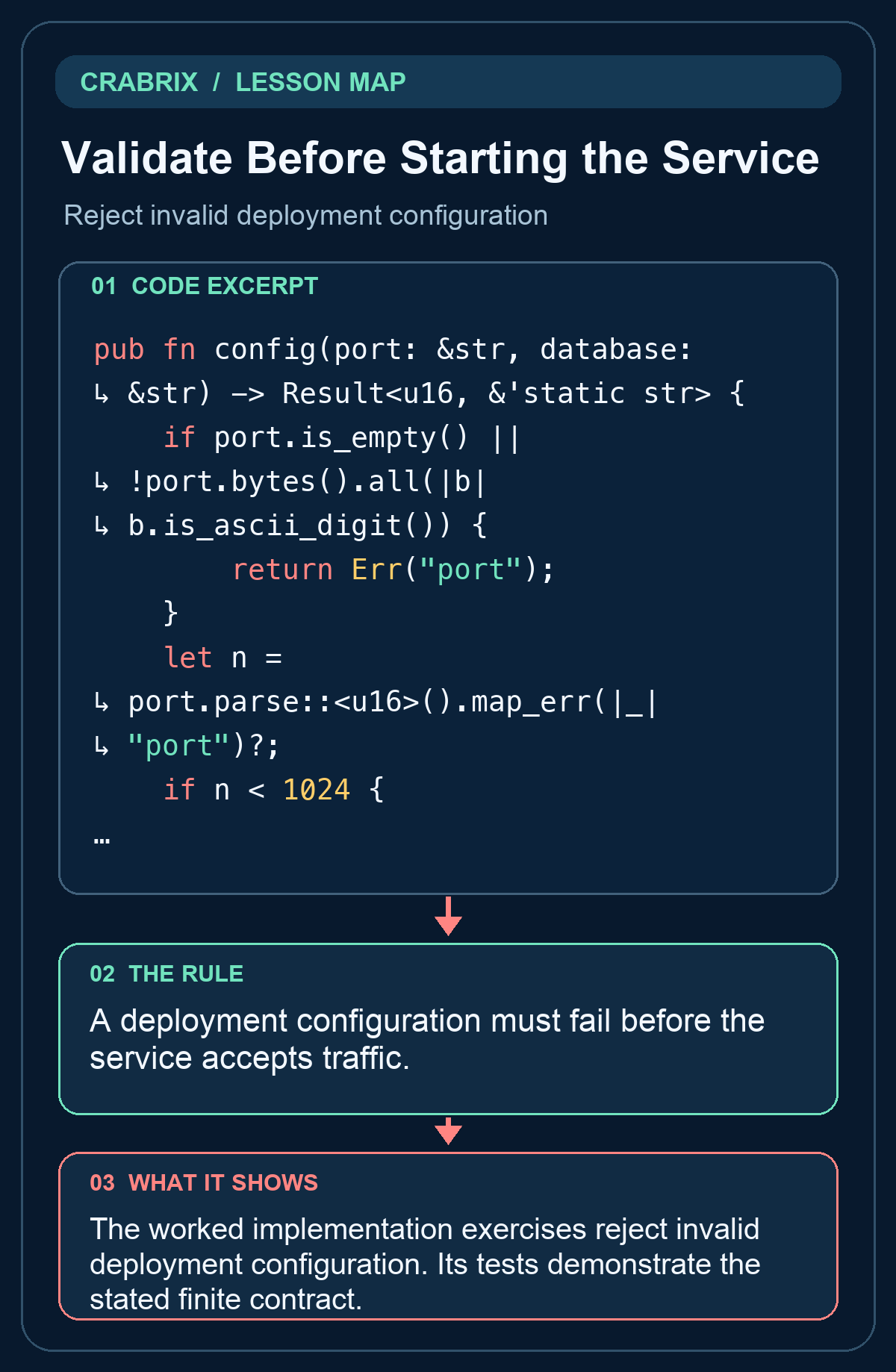
The worked implementation exercises reject invalid deployment configuration. Its tests demonstrate the stated finite contract.
Practice starter
pub fn config(port: &str, database: &str) -> Result<u16,&'static str> {
    todo!("implement the contract")
}
Try it
Accept an ASCII-digit decimal port in 1024..=65535 and a nonempty database string without whitespace. Return port for port errors and database for database errors; validate the port first. Keep the public signature. Open the compiler lab and edit solution.rs; do not edit the private verification caller.
What success looks like: The separate caller accepts the changed solution and rejects unchanged TODO, a wrong implementation and a printed success message.
Check your understanding
What does accepting a database configuration string prove?
Reveal the answer
- That every future request will succeed
- Only the declared syntactic policy
- That credentials and migrations work
Configuration parsing, connectivity and readiness are separate checks.
Go deeper
Common misconception: That credentials and migrations work
A deployment configuration must fail before the service accepts traffic.
- Identify the boundary: Reject invalid deployment configuration. Write down its accepted inputs and observable output.
- Exercise the failure: Configuration parsing, connectivity and readiness are separate checks.
- Check the independent caller: Accept an ASCII-digit decimal port in 1024..=65535 and a nonempty database string without whitespace. Return port for port errors and database for database errors; validate the port first.
Transfer challenge: Apply this contract to Task Ledger, introduce the failure described in the lesson, and show the failing check before fixing it.
Connections
- Make Checks Block Delivery: Require all declared release checks
- Bind an Artifact to Its Source: Verify release identity and digest metadata