

Understand it
A release artifact should have an identity that can be compared with the tested source and the expected content digest. Reusing a mutable latest filename makes rollback and incident investigation harder. Retain the source revision, exact target, digest and verification receipt beside immutable artifact bytes.
The lab validates metadata: a full lowercase 40-hex Git object ID, a lowercase 64-hex SHA-256 digest and an exact match with an independently supplied expected digest. It does not calculate SHA-256 or prove the claim by validating string shape. The actual delivery script computes the digest from built bytes with a standard tool, then compares it before promotion. A digest detects changed bytes when the expected digest is trusted; it is not an author signature. Keep signing and provenance decisions explicit rather than calling a checksum an authenticity guarantee.
The route project is Task Ledger: first keep a reproducible source history, then expose its data through a CLI and HTTP boundary, persist it in SQL, diagnose failures and prepare a release. This lesson owns one contract in that project. Run the worked example before changing the starter and explain which input makes the tempting shortcut fail.
Terminal practice: Run the desktop delivery script, inspect its source revision and computed artifact SHA-256, then modify an artifact copy and observe verification fail.
The compiler lab is independent of the reading question. Edit solution.rs; the app supplies a separate caller with normal, empty and adversarial inputs. A successful unchanged demonstration does not prove your implementation. After the lab, apply the same contract to the route companion project. Its README separates the on-device adapter from the desktop Cargo/TCP profile.
Read the code
pub fn artifact_matches(
    commit: &str,
    digest: &str,
    expected: &str,
) -> bool {
    let hex = |s: &str, n: usize| {
        s.len() == n
            && s.bytes().all(|b| {
                b.is_ascii_digit() || (b'a'..=b'f').contains(&b)
            })
    };
    hex(commit, 40)
        && hex(digest, 64)
        && hex(expected, 64)
        && digest == expected
}

fn main() {
    assert_eq!(
        artifact_matches(
            &"a".repeat(40),
            &"b".repeat(64),
            &"b".repeat(64)
        ),
        true,
        "case 1"
    );
    assert_eq!(
        artifact_matches("main", &"b".repeat(64), &"b".repeat(64)),
        false,
        "case 2"
    );
    assert_eq!(
        artifact_matches(
            &"a".repeat(40),
            &"b".repeat(64),
            &"c".repeat(64)
        ),
        false,
        "case 3"
    );
    assert_eq!(
        artifact_matches(
            &"A".repeat(40),
            &"b".repeat(64),
            &"b".repeat(64)
        ),
        false,
        "case 4"
    );
    assert_eq!(
        artifact_matches(&"a".repeat(40), "", ""),
        false,
        "case 5"
    );
    println!("worked example passed");
}
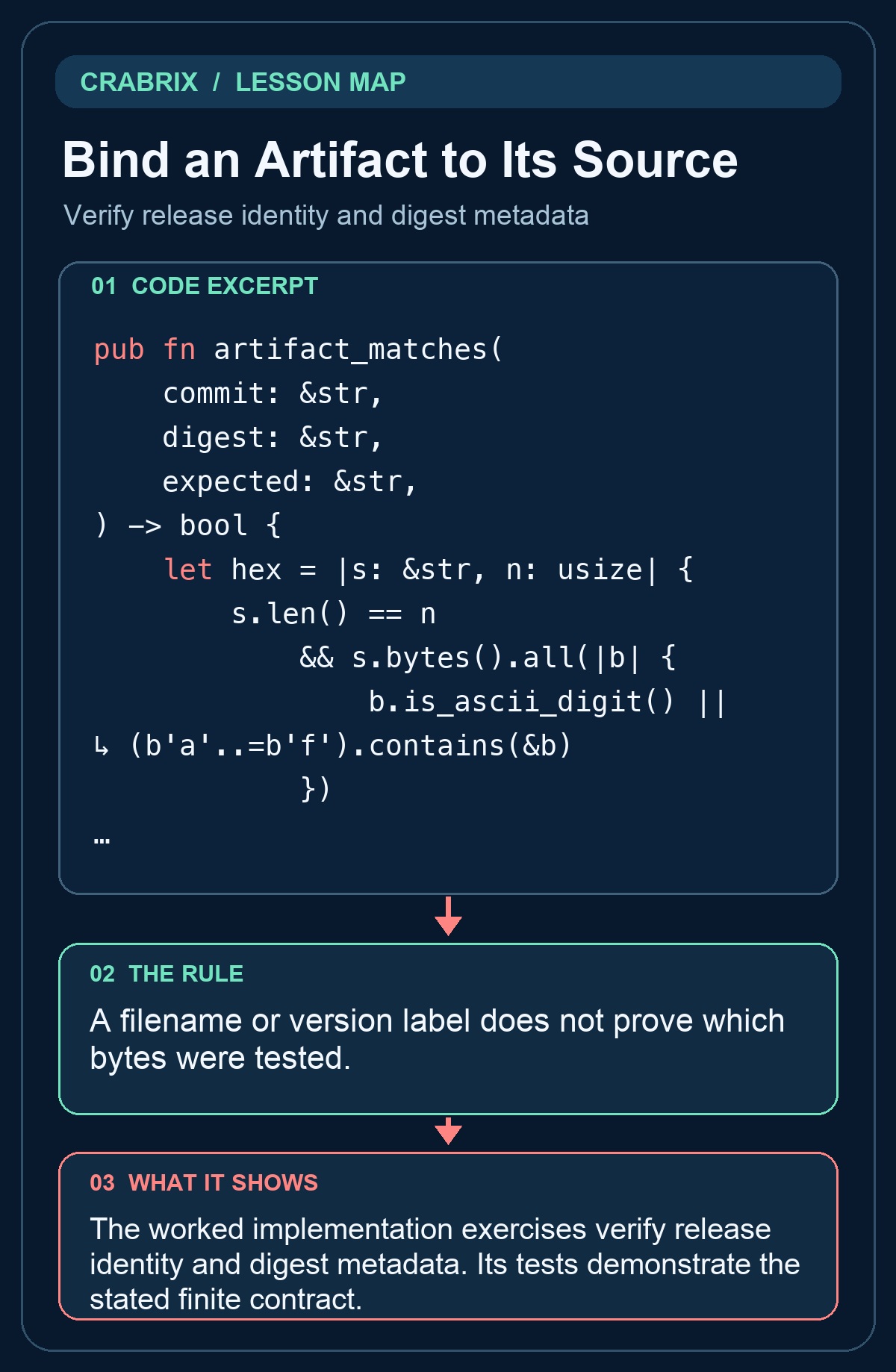
The worked implementation exercises verify release identity and digest metadata. Its tests demonstrate the stated finite contract.
Practice starter
pub fn artifact_matches(commit: &str, digest: &str, expected: &str) -> bool {
    todo!("implement the contract")
}
Try it
Validate lowercase hexadecimal commit(40) and digest/expected(64), then require digest==expected. This checks metadata only; actual digest computation belongs to the supplied build-byte verification step. Keep the public signature. Open the compiler lab and edit solution.rs; do not edit the private verification caller.
What success looks like: The separate caller accepts the changed solution and rejects unchanged TODO, a wrong implementation and a printed success message.
Check your understanding
Does a well-formed SHA-256 string prove the artifact bytes match?
Reveal the answer
- No, compute and compare the actual bytes against a trusted expected digest
- Yes, every 64-character value proves integrity
- A checksum automatically identifies the publisher
String shape, byte integrity and publisher authenticity are different properties.
Go deeper
Common misconception: Yes, every 64-character value proves integrity
A filename or version label does not prove which bytes were tested.
- Identify the boundary: Verify release identity and digest metadata. Write down its accepted inputs and observable output.
- Exercise the failure: String shape, byte integrity and publisher authenticity are different properties.
- Check the independent caller: Validate lowercase hexadecimal commit(40) and digest/expected(64), then require digest==expected. This checks metadata only; actual digest computation belongs to the supplied build-byte verification step.
Transfer challenge: Apply this contract to Task Ledger, introduce the failure described in the lesson, and show the failing check before fixing it.
Connections
- Validate Before Starting the Service: Reject invalid deployment configuration
- Release, Observe and Recover: Keep a known-good version until the candidate is healthy