

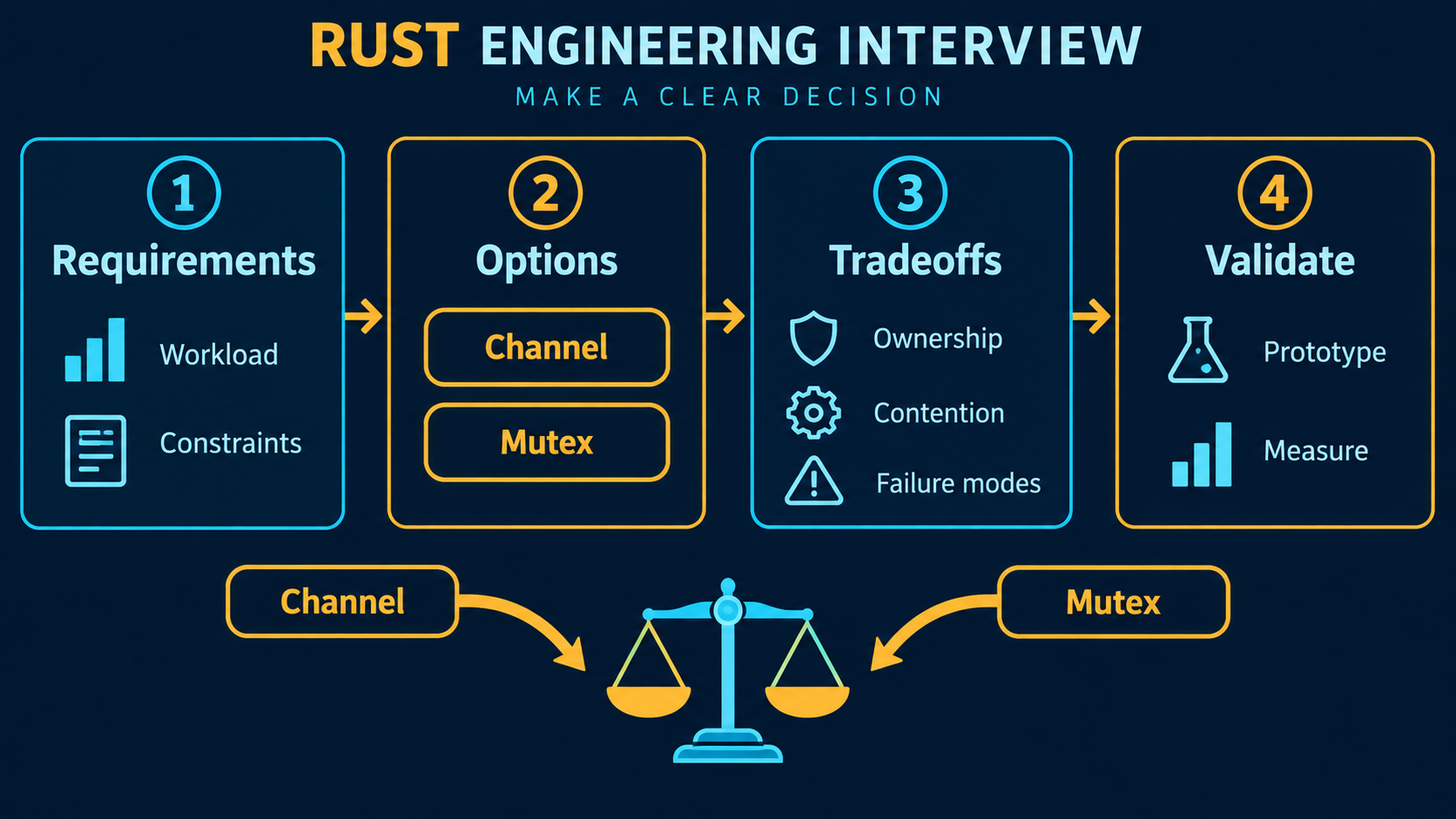
Understand it
A senior answer does not call one tool universally best. Name the current constraint, compare at least two viable choices, state the cost you accept, and say what evidence would change the decision.
A tradeoff answer begins with the constraint that matters now. For a mobile Rust editor, local compilation may improve privacy and offline capability while consuming more device resources and supporting a narrower toolchain target. A server compiler may support more crates but introduce network dependence and operational cost. Neither is universally superior. State which users and failure modes the current design serves, and which cost you are accepting.
Compare at least two viable options on the same dimensions: correctness, latency, memory, maintenance, security boundary, and reversibility. Avoid a table of generic advantages that does not change a decision. If p95 latency is the requirement, define its measurement. If offline use matters, define which operations must work offline. If privacy is the requirement, identify exactly what data crosses a network boundary. A constraint becomes useful only when it can be observed or tested.
In an interview, make a provisional recommendation and name the evidence that would change it. 'I would start with option A because our workloads are small; if production traces show queue age above two seconds, I would revisit B' is stronger than claiming A is best. Mention migration cost if the choice becomes difficult to reverse. Clear communication is not certainty; it is a decision that another engineer can inspect, challenge, and update.
Interview follow-up: What metric would reveal that your chosen queue capacity harms tail latency? How would you gather that evidence?
Read the code
enum Choice {
    Channel,
    Mutex,
}
// Choose from ownership and workload facts.
The enum only records the two options; your answer still has to name the facts that pick one.
Practice starter
// Requirement: 16 MiB work budget, offline operation, bounded inputs.
// Compare two implementations under those same constraints.Try it
Compare Channel and Mutex for one workload. Say which you would start with, the cost you accept, and what evidence would change your mind.
What success looks like: Another engineer could test your recommendation, because it names a constraint, a cost and a condition for revisiting it.
Check your understanding
Which answer connects a proposed design to a falsifiable decision criterion?
Reveal the answer
- Choose a candidate, state the accepted cost and name evidence that would change the choice.
- List many implementation features without tying them to user constraints.
- Claim the faster asymptotic bound settles latency at every input size.
A useful recommendation states constraints, alternatives, a measurable outcome and the condition for revisiting it.
Go deeper
Common misconception: List many implementation features without tying them to user constraints.
A feature list gives the listener nothing to test. Tie each point to a constraint and name what result would change the choice.
- Identify the contract: Tie a choice to constraints and a failure mode.
- Trace the concrete example: The enum only records the two options; your answer still has to name the facts that pick one.
- Test the changed constraint: What metric would reveal that your chosen queue capacity harms tail latency? How would you gather that evidence?
Transfer challenge: What metric would reveal that your chosen queue capacity harms tail latency? How would you gather that evidence?
Connections
- Debugging Out Loud: Form a hypothesis and request one discriminating fact
- Clarify Requirements: Turn a broad prompt into boundaries and invariants
Learn this lesson with AI
Paste this into Claude, Codex, Cursor or another agent connected to Crabrix Academy. It contains only this lesson’s public details.
I'm learning Rust with Crabrix Academy. Teach me this lesson with the Crabrix Academy tools.
Lesson: Communicate a Tradeoff (courseId "interview", lessonId "q-tradeoff-communication")
Link: https://crabrix.com/learn/interview/q-tradeoff-communication/
Goal: A senior answer does not call one tool universally best.
Practice: open the starter in the Crabrix Playground (https://crabrix.com/playground/?lesson=interview/q-tradeoff-communication) and I will write the code there.
Explain it step by step for my level, let me write the code myself, give hints before any solution, and do not mark anything as passed: only Crabrix checks do that.