

Understand it
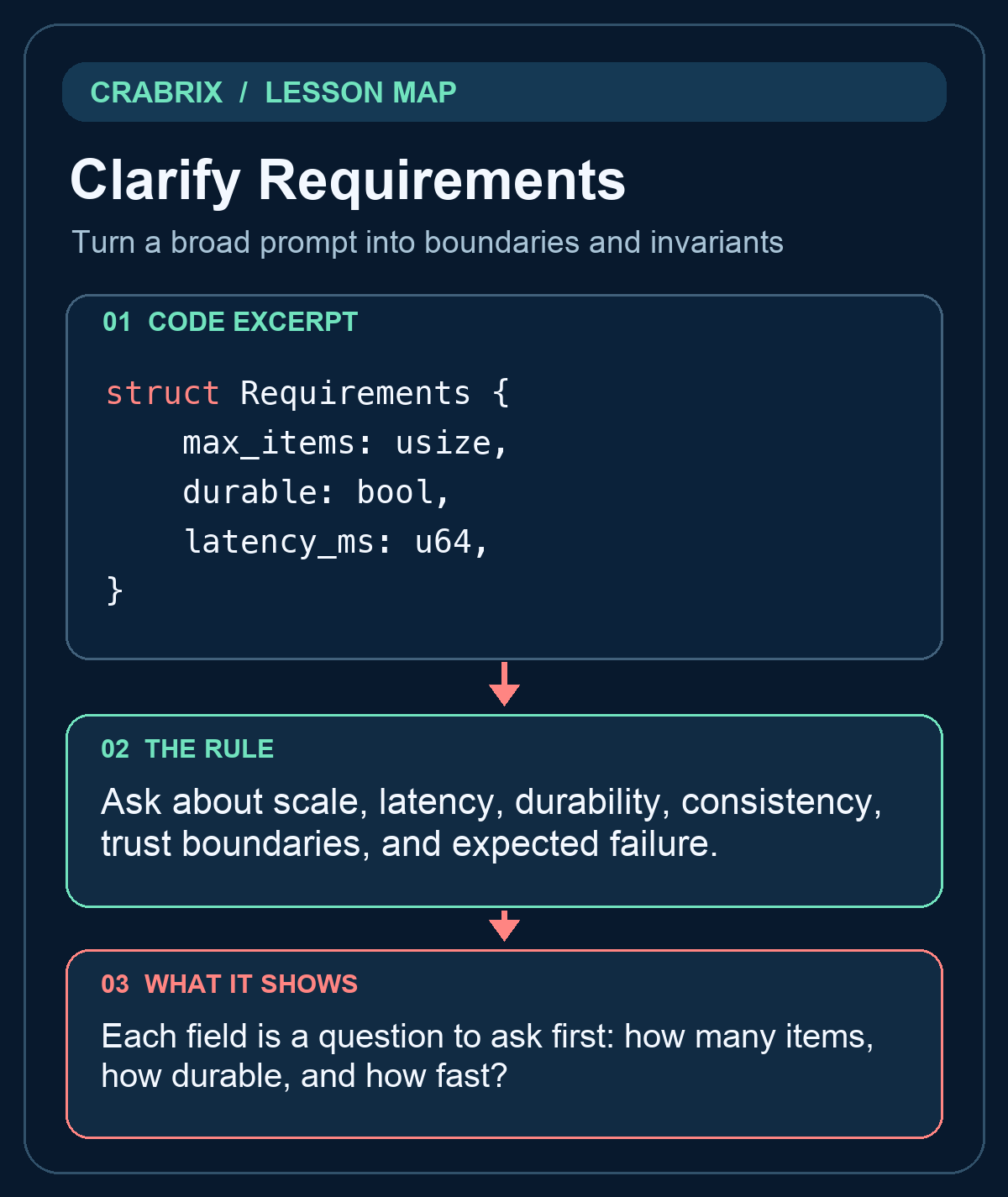
Ask about scale, latency, durability, consistency, trust boundaries, and expected failure. Good clarifying questions shrink the design space and reveal which guarantee the interviewer actually wants explored.
A broad design prompt hides choices that determine the architecture. Ask who the users are, what action they need, expected traffic, size of stored data, latency targets, and what must survive a failure. Then ask about consistency, security boundaries, retention, and existing systems. Prioritize questions that change the design. If the interviewer cannot give numbers, state reasonable assumptions and proceed; endless clarification can become a way to avoid making a design decision.
For a file-sharing service, the first questions might be maximum file size, whether recipients need accounts, whether links expire, and whether uploads must be resumable. These answers change storage, authentication, and API design. A million tiny text files and a thousand large videos are different workloads even if both are called 'file sharing'. Draw the success path and one failure path after the key assumptions are explicit.
In an interview, summarize the agreed contract back to the interviewer: 'We need uploads under X size, downloads within Y latency, and links that expire after Z.' Mark unknowns separately. Then choose a minimal architecture that meets those constraints and describe how it scales or fails. Good clarifying questions shrink the search space; they are not a performance of completeness. The goal is to expose the invariant you must protect and the metric by which success will be judged.
Interview follow-up: What changes if offline edits must survive a crash, but shared rooms deliberately expire and can end on server restart?
Read the code
struct Requirements {
    max_items: usize,
    durable: bool,
    latency_ms: u64,
}
Each field is a question to ask first: how many items, how durable, and how fast?
Practice starter
struct Requirements {
    max_items: usize,
    survives_restart: bool,
    max_loss_seconds: u32,
}Try it
Take a broad prompt such as a file-sharing service and turn it into values for max_items, survives_restart and max_loss_seconds, stating each assumption.
What success looks like: Each answer changes the design, and unknowns are marked as assumptions rather than guessed silently.
Check your understanding
Which clarification changes the storage design before implementation?
Reveal the answer
- Ask whether an acknowledged write must survive restart and how much loss is acceptable.
- Treat surviving restart as equivalent to keeping a value in process memory.
- Choose a data structure before establishing input size or failure semantics.
Scale and failure requirements determine viable designs. Define acknowledgement, durability, latency and trust boundaries in observable terms.
Go deeper
Common misconception: Treat surviving restart as equivalent to keeping a value in process memory.
Process memory is gone when the process exits. If an acknowledged write must survive a restart, it has to reach durable storage before the acknowledgement.
- Identify the contract: Turn a broad prompt into boundaries and invariants.
- Trace the concrete example: Each field is a question to ask first: how many items, how durable, and how fast?
- Test the changed constraint: What changes if offline edits must survive a crash, but shared rooms deliberately expire and can end on server restart?
Transfer challenge: What changes if offline edits must survive a crash, but shared rooms deliberately expire and can end on server restart?
Connections
- Communicate a Tradeoff: Tie a choice to constraints and a failure mode
- Review Rust Code: Prioritize correctness, API contracts, then style
Learn this lesson with AI
Paste this into Claude, Codex, Cursor or another agent connected to Crabrix Academy. It contains only this lesson’s public details.
I'm learning Rust with Crabrix Academy. Teach me this lesson with the Crabrix Academy tools.
Lesson: Clarify Requirements (courseId "interview", lessonId "q-requirements")
Link: https://crabrix.com/learn/interview/q-requirements/
Goal: Ask about scale, latency, durability, consistency, trust boundaries, and expected failure.
Practice: open the starter in the Crabrix Playground (https://crabrix.com/playground/?lesson=interview/q-requirements) and I will write the code there.
Explain it step by step for my level, let me write the code myself, give hints before any solution, and do not mark anything as passed: only Crabrix checks do that.