

Understand it
Averages can hide slow requests. A service with many quick responses and a few multi-second waits may have an acceptable mean while some users regularly time out. Record a latency distribution and inspect tail behavior alongside throughput and error rate.
This exercise defines p95 using the nearest-rank rule: sort a copy of the positive or zero millisecond observations, choose rank ceil(0.95*n), and return that element. Return None for an empty sample. Do not mutate the caller's measurements or invent interpolated values. A percentile from a small sample has limited statistical precision; the exact calculation is not evidence that the load generator or measurement conditions were realistic. The desktop companion keeps raw samples, concurrency and toolchain identity with a before/after report.
The route project is Task Ledger: first keep a reproducible source history, then expose its data through a CLI and HTTP boundary, persist it in SQL, diagnose failures and prepare a release. This lesson owns one contract in that project. Run the worked example before changing the starter and explain which input makes the tempting shortcut fail.
Terminal practice: Run python3 scripts/latency.py in the desktop companion, retain its raw samples and error count, then compare p95 before and after a change.
The compiler lab is independent of the reading question. Edit solution.rs; the app supplies a separate caller with normal, empty and adversarial inputs. A successful unchanged demonstration does not prove your implementation. After the lab, apply the same contract to the route companion project. Its README separates the on-device adapter from the desktop Cargo/TCP profile.
Read the code
pub fn p95(samples: &[u64]) -> Option<u64> {
    if samples.is_empty() {
        return None;
    }
    let mut sorted = samples.to_vec();
    sorted.sort_unstable();
    let n = sorted.len();
    let rank = n - n / 20;
    Some(sorted[rank - 1])
}

fn main() {
    assert_eq!(p95(&[1, 2, 3, 100]), Some(100), "case 1");
    assert_eq!(p95(&[]), None, "case 2");
    assert_eq!(p95(&[7]), Some(7), "case 3");
    assert_eq!(
        p95(&(1..=20).collect::<Vec<u64>>()),
        Some(19),
        "case 4"
    );
    assert_eq!(p95(&[9, 1, 9, 0]), Some(9), "case 5");
    println!("worked example passed");
}
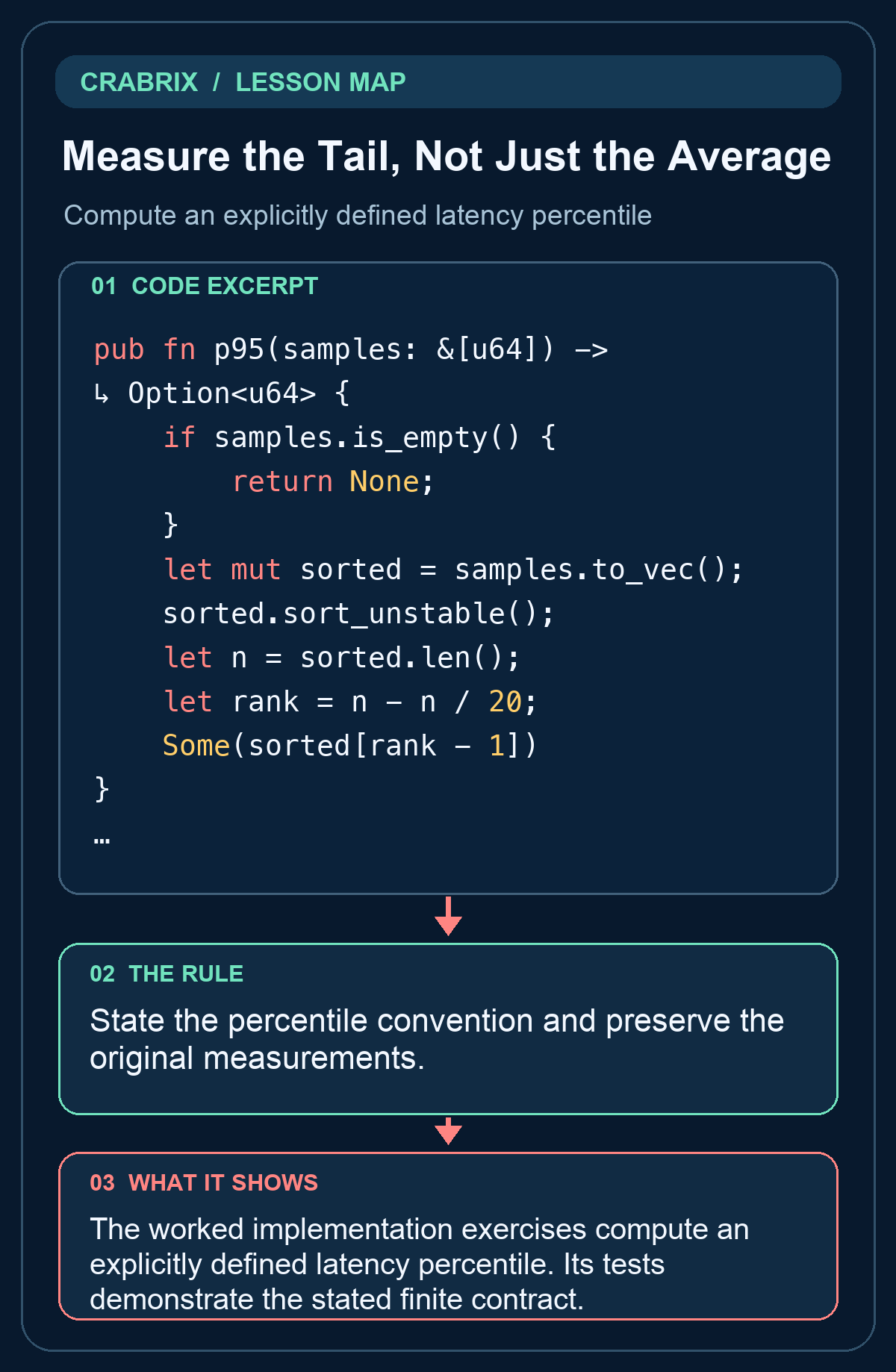
The worked implementation exercises compute an explicitly defined latency percentile. Its tests demonstrate the stated finite contract.
Practice starter
pub fn p95(samples: &[u64]) -> Option<u64> {
    todo!("implement the contract")
}
Try it
Return nearest-rank p95: sort a copy and choose rank ceil(0.95*n), using one-based ranks. Empty input returns None. Retain exact u64 observations. Keep the public signature. Open the compiler lab and edit solution.rs; do not edit the private verification caller.
What success looks like: The separate caller accepts the changed solution and rejects unchanged TODO, a wrong implementation and a printed success message.
Check your understanding
Why can a good average coexist with a poor user experience?
Reveal the answer
- Percentiles eliminate the need for sample context
- Slow tail requests can be hidden by many fast ones
- The average is always the slowest request
A mean alone does not describe the slow tail or the measurement conditions.
Go deeper
Common misconception: The average is always the slowest request
State the percentile convention and preserve the original measurements.
- Identify the boundary: Compute an explicitly defined latency percentile. Write down its accepted inputs and observable output.
- Exercise the failure: A mean alone does not describe the slow tail or the measurement conditions.
- Check the independent caller: Return nearest-rank p95: sort a copy and choose rank ceil(0.95*n), using one-based ranks. Empty input returns None. Retain exact u64 observations.
Transfer challenge: Apply this contract to Task Ledger, introduce the failure described in the lesson, and show the failing check before fixing it.
Connections
- Propagate One Request Identity: Validate a bounded correlation ID
- Bound the Retry Budget: Retry transient failures within attempt and time limits