

Understand it
A function that only inspects text does not need a String allocation from every caller. A borrowed &str is often the simplest signature. AsRef<str> is useful when an API intentionally accepts several owned or borrowed string-like types and immediately obtains a string slice from them. It is a cheap reference conversion, not a general parsing or validation mechanism.
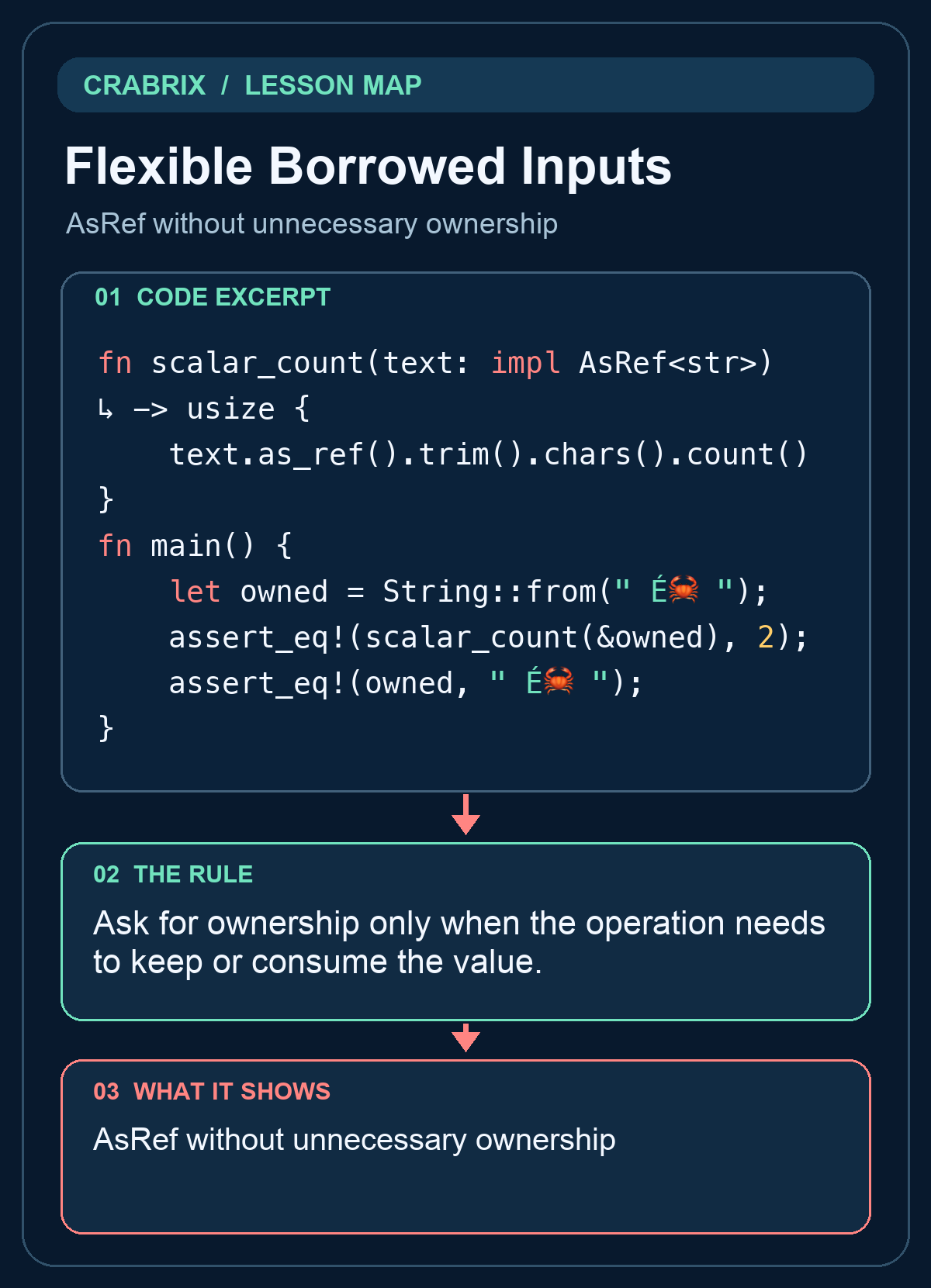
The example accepts a generic input, calls as_ref(), trims surrounding whitespace, and returns the number of Unicode scalar values. It never stores a reference after the call returns. Taking T by value still moves an owned String passed directly; callers that want to keep it can pass a reference. Generic syntax does not repeal ownership rules.
Choose the narrowest useful contract. A public function taking &str is easy to read and accepts &String through coercion. An AsRef<Path> parameter can be convenient for a file adapter, but path conversion does not grant filesystem permission. Similarly, AsRef<str> does not prove a string is a valid URL, port, or record. Keep the validated domain constructor from the earlier lesson as a separate operation.
Local compiler profile: standard library only. The lab calls the same function with a string literal, a String, and a borrowed String. It includes accented text and an emoji so byte length cannot accidentally pass as character count. Rust chars are Unicode scalar values; they are not the same as user-perceived grapheme clusters, so describe the result precisely rather than calling it a universal display width.
Read the code
fn scalar_count(text: impl AsRef<str>) -> usize {
    text.as_ref().trim().chars().count()
}
fn main() {
    let owned = String::from(" É🦀 ");
    assert_eq!(scalar_count(&owned), 2);
    assert_eq!(owned, " É🦀 ");
}
AsRef without unnecessary ownership
Try it
Trim surrounding whitespace and count Unicode scalar values for any AsRef<str> input. This is not byte length or grapheme count. In the Crabrix app, open the compiler lab and complete the supplied function in solution.rs. The reading question is a separate exercise.
What success looks like: The local compiler accepts the changed solution and the separate verification harness finishes all normal and boundary cases. Printing a success message alone does not complete this lab.
Check your understanding
If an owned String is passed by value to fn f<T: AsRef<str>>(value: T), is the original still available?
Reveal the answer
- Always, because AsRef implies Copy
- No, unless it was borrowed or cloned before the call
- Only when the text is ASCII
AsRef supplies a borrowed view inside the function. Passing the owned argument by value still moves it.
Go deeper
Common misconception: AsRef means arguments can never be moved.
The conversion is borrowed, but the parameter's ownership mode still matters.
- Accept: Choose a borrowed slice or a justified generic input.
- View: Call as_ref only for the lifetime of the operation.
- Specify: Count scalar values, not bytes or grapheme clusters.
Transfer challenge: Compare a &str API and an impl AsRef<str> API at three call sites. Keep the simpler public contract unless flexibility has a concrete benefit.
Connections
- Compose Optional Fallible Input: map, transpose, and explicit defaults