

Understand it
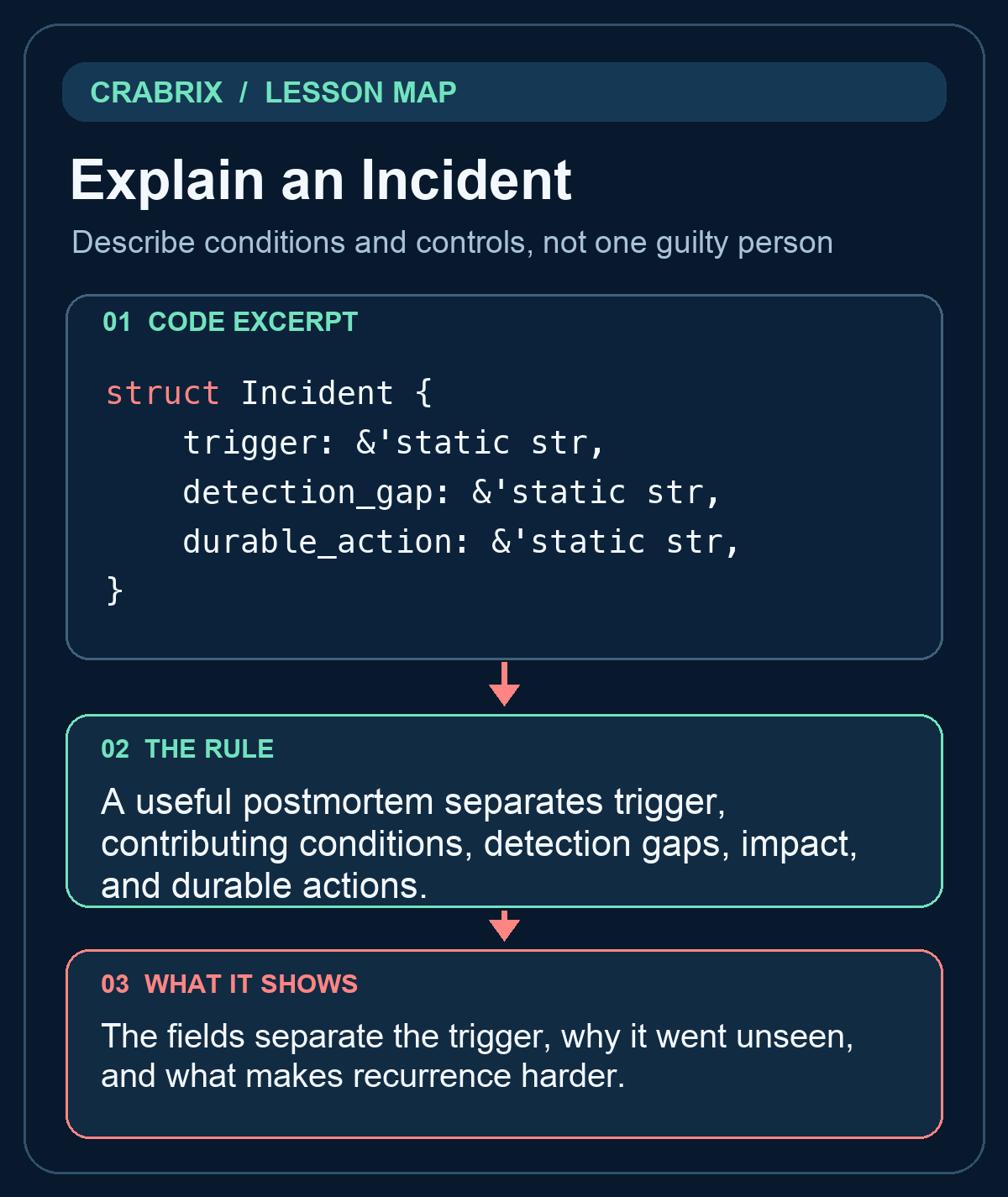
A useful postmortem separates trigger, contributing conditions, detection gaps, impact, and durable actions. Prefer controls that make recurrence harder over promises to be more careful.
A postmortem is a tool for learning from an incident, not for assigning blame to one operator. State the timeline in observable events: trigger, detection, mitigation, recovery, and customer impact. Then separate the immediate trigger from conditions that made the incident possible or prolonged it. An expired certificate may trigger an outage, while missing alerts, unclear ownership, and a fragile renewal process are contributing conditions. Treat uncertainty honestly when logs are incomplete.
Quantify impact with the best available evidence: affected users, duration, failed requests, lost or delayed work, and whether data was at risk. Identify what worked during response as well as what failed. For actions, prefer controls that change the system: an automated renewal test, an alert on certificate expiry, a rollback path, or a runbook exercised in a drill. 'Be more careful' is not a measurable control.
In an interview, describe how each action maps to a failure mode, who owns it, and how completion will be verified. Avoid overloading the list with low-value tasks that no team can finish. Include follow-up monitoring to check whether the control actually works in production. A strong postmortem reduces the chance or impact of recurrence and gives future responders a clearer path, while preserving a truthful record of what happened.
Interview follow-up: What would demonstrate the fix protects users during the next overload rather than merely improving average throughput?
Read the code
struct Incident {
    trigger: &'static str,
    detection_gap: &'static str,
    durable_action: &'static str,
}
The fields separate the trigger, why it went unseen, and what makes recurrence harder.
Practice starter
// Trigger: arrival rate exceeded worker throughput.
// Detection gap: memory and queue age were not monitored.Try it
Fill in trigger, detection_gap and durable_action for an unbounded-queue incident. Then say who owns the action and how it is verified.
What success looks like: Your action changes a failure mechanism and names a verification; it does not ask anyone to be more careful.
Check your understanding
Which action directly reduces recurrence of an unbounded-queue incident?
Reveal the answer
- Bound admission, define overload behaviour and verify it under sustained excess load.
- Record the incident timeline but leave admission and monitoring unchanged.
- Ask operators to remember to restart the service earlier next time.
A durable control changes a failure mechanism and has an owner and a verification method. Preserve a blameless account of contributing conditions.
Go deeper
Common misconception: Record the incident timeline but leave admission and monitoring unchanged.
A timeline explains what happened but changes nothing in the system. The same overload fills the same queue until admission or monitoring changes.
- Identify the contract: Describe conditions and controls, not one guilty person.
- Trace the concrete example: The fields separate the trigger, why it went unseen, and what makes recurrence harder.
- Test the changed constraint: What would demonstrate the fix protects users during the next overload rather than merely improving average throughput?
Transfer challenge: What would demonstrate the fix protects users during the next overload rather than merely improving average throughput?
Connections
- Review Rust Code: Prioritize correctness, API contracts, then style
- Cell, RefCell and Runtime Borrows: Interior mutability without confusing Send and Sync
Learn this lesson with AI
Paste this into Claude, Codex, Cursor or another agent connected to Crabrix Academy. It contains only this lesson’s public details.
I'm learning Rust with Crabrix Academy. Teach me this lesson with the Crabrix Academy tools.
Lesson: Explain an Incident (courseId "interview", lessonId "q-postmortem")
Link: https://crabrix.com/learn/interview/q-postmortem/
Goal: A useful postmortem separates trigger, contributing conditions, detection gaps, impact, and durable actions.
Practice: open the starter in the Crabrix Playground (https://crabrix.com/playground/?lesson=interview/q-postmortem) and I will write the code there.
Explain it step by step for my level, let me write the code myself, give hints before any solution, and do not mark anything as passed: only Crabrix checks do that.