
Algorithm Atlas · worked example
See the algorithm, step by step
Emit null markers as well as values so structure is reconstructible, not only traversal order.
This call is starting. Local values appear as they are initialized.
Data & variables
Changed Source indexExample input
tree=[1]Follow the code. Data appears here when it enters scope.
Call stack · 1 frame
maincall 1
Rust source
Line 59type Tree = Option<Box<Node>>;
struct Node {
value: i32,
left: Tree,
right: Tree,
}
fn node(value: i32, left: Tree, right: Tree) -> Tree {
Some(Box::new(Node { value, left, right }))
}
fn serialize(root: &Tree) -> String {
fn visit(root: &Tree, out: &mut Vec<String>) {
match root {
None => out.push("#".into()),
Some(n) => {
out.push(n.value.to_string());
visit(&n.left, out);
visit(&n.right, out);
}
}
}
let mut out = Vec::new();
visit(root, &mut out);
out.join(",")
}
fn deserialize(text: &str) -> Tree {
// Tokens arrive in the same preorder, so each # closes exactly one child.
fn build<'a>(tokens: &mut impl Iterator<Item = &'a str>) -> Tree {
match tokens.next() {
None | Some("#") => None,
Some(token) => {
let value = token.parse().unwrap();
let left = build(tokens);
let right = build(tokens);
node(value, left, right)
}
}
}
build(&mut text.split(','))
}
fn round_trip(root: &Tree) -> String {
let text = serialize(root);
assert_eq!(serialize(&deserialize(&text)), text);
text
}
fn inorder_values(root: &Tree) -> Vec<i32> {
match root {
None => Vec::new(),
Some(n) => {
let mut out = inorder_values(&n.left);
out.push(n.value);
out.extend(inorder_values(&n.right));
out
}
}
}
fn main() {
let result = round_trip(&node(1, None, None));
println!("{result}");
}
Try your own version
Change the independent fixture `tree=[1]` in a legal way, then compare the result with your prediction. Explain how the same invariant applies to the separate visible challenge `tree=[1,2,3,null,null,4,5]`.
Open personal copy in Playground ↗Start with this exact source and input, change a value, then use Run or Debug locally. This replay stays attached to the original example.
Recordings use a native Rust target. Playground runs on wasm32-wasip1; target-sized types such as usize can have different limits.
Understand it
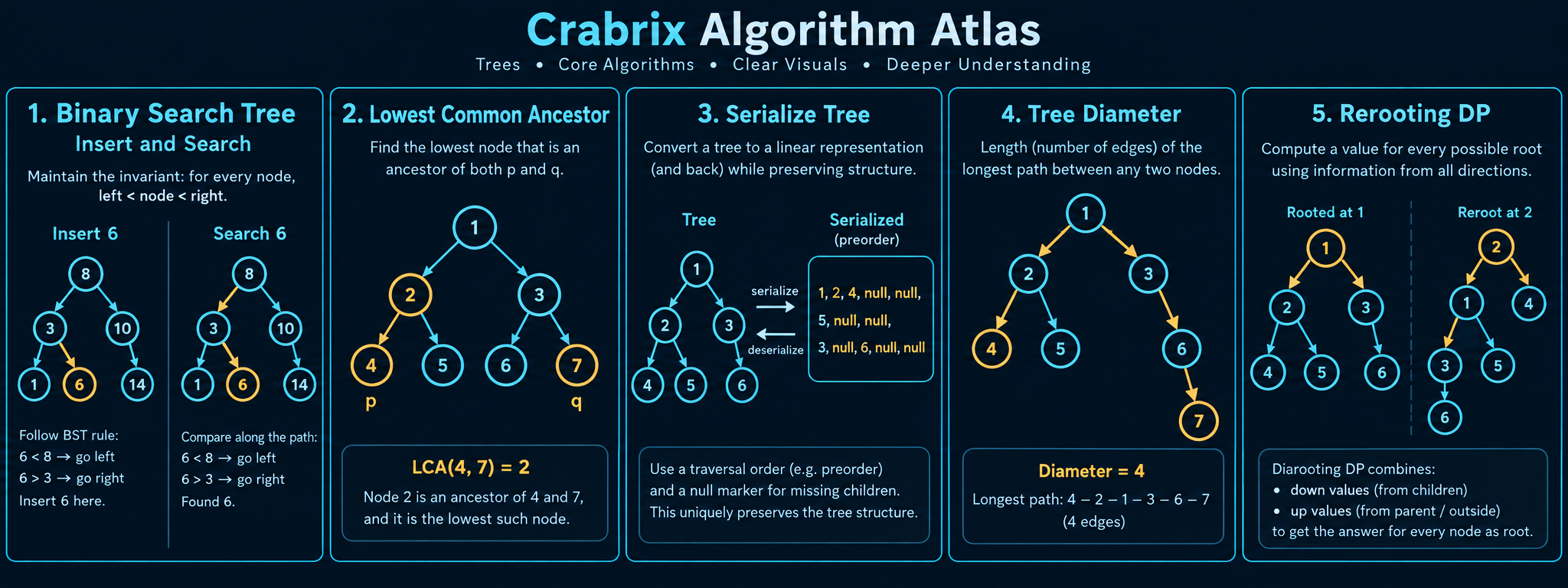
Values alone do not encode the tree's shape. The worked program demonstrates this invariant on an independent fixture, so you can study the implementation before predicting the challenge result.
For teaching input tree=[1], the worked program returns 1,#,#. Its functions are complete and use only std. Adapt the same state transitions to the visible challenge input tree=[1,2,3,null,null,4,5]; predict that result before opening the answer reveal. The precise contract is: Given tree=[...], a compact level-order tree where null omits a node, serialize it in preorder using comma separators and # for every missing child. Given data=... instead, deserialize that preorder text and return the tree's inorder values.
Return canonical output: lowercase booleans, decimal integers without leading zeros, comma-separated values and semicolon-separated groups, with no extra whitespace or final newline. Whole medians use integer form and half medians use .5. Textual sentinels such as none and # retain their stated meaning. String and character-grid fixtures use ASCII unless the lesson explicitly specifies Unicode scalar values.
Solve the exact task, not just the visible example: Given tree=[...], a compact level-order tree where null omits a node, serialize it in preorder using comma separators and # for every missing child. Given data=... instead, deserialize that preorder text and return the tree's inorder values. On input tree=[1,2,3,null,null,4,5], predict the output before opening the answer reveal. The revealed output is a test oracle for this case, while private checks exercise other legal cases. Start by stating the input grammar and output format in your own words. Parse the complete input, including surrounding whitespace, before relying on any convenient positions in the example.
Build the solution around one maintained claim: Emit null markers as well as values so structure is reconstructible, not only traversal order. Decide what state represents that claim, how it is initialized, what a single update does, and when the algorithm stops. A tree result is built from a node and its children. Decide whether information flows downward, upward, or in level order. Trace the visible input by hand and record at least two intermediate states, not only the final answer. If the trace cannot justify your predicted output, there is a gap between the idea and the implementation.
Check both correctness and cost. The intended bound is O(n) time · O(n) output; explain which operation dominates it and how many times the input can trigger that operation. Test a missing root, a leaf, a skewed tree, and equal or duplicate values when ordering rules depend on them. Add one small case that should succeed, one boundary case, and one case chosen to challenge the invariant. Compare your hand result with the program's result, then use a failing case to fix the earliest incorrect state transition rather than patching the final output.
The pattern
Emit null markers as well as values so structure is reconstructible, not only traversal order.
When to use it: persistence, transport, tree cloning
Complexity: O(n) time · O(n) output
Input: tree=[1,2,3,null,null,4,5]
Read the code
type Tree = Option<Box<Node>>;
struct Node {
    value: i32,
    left: Tree,
    right: Tree,
}
fn node(value: i32, left: Tree, right: Tree) -> Tree {
    Some(Box::new(Node { value, left, right }))
}

fn serialize(root: &Tree) -> String {
    fn visit(root: &Tree, out: &mut Vec<String>) {
        match root {
            None => out.push("#".into()),
            Some(n) => {
                out.push(n.value.to_string());
                visit(&n.left, out);
                visit(&n.right, out);
            }
        }
    }
    let mut out = Vec::new();
    visit(root, &mut out);
    out.join(",")
}
fn deserialize(text: &str) -> Tree {
    // Tokens arrive in the same preorder, so each # closes exactly one child.
    fn build<'a>(tokens: &mut impl Iterator<Item = &'a str>) -> Tree {
        match tokens.next() {
            None | Some("#") => None,
            Some(token) => {
                let value = token.parse().unwrap();
                let left = build(tokens);
                let right = build(tokens);
                node(value, left, right)
            }
        }
    }
    build(&mut text.split(','))
}
fn round_trip(root: &Tree) -> String {
    let text = serialize(root);
    assert_eq!(serialize(&deserialize(&text)), text);
    text
}
fn inorder_values(root: &Tree) -> Vec<i32> {
    match root {
        None => Vec::new(),
        Some(n) => {
            let mut out = inorder_values(&n.left);
            out.push(n.value);
            out.extend(inorder_values(&n.right));
            out
        }
    }
}

fn main() {
    let result = round_trip(&node(1, None, None));
    println!("{result}");
}
Complete std-only tree-serialize program for its typed teaching fixture. Parsing and output construction are separate from the core algorithm.
Practice starter
pub fn solve(input: &str) -> String {
    // Given tree=[...], a compact level-order tree where null omits a node, serialize it in preorder using comma separators and # for every missing child. Given data=... instead, deserialize that preorder text and return the tree's inorder values.
    // Trim surrounding whitespace; implement parsing and the algorithm.
    let _ = input;
    todo!("implement tree-serialize")
}
Try it
Given tree=[...], a compact level-order tree where null omits a node, serialize it in preorder using comma separators and # for every missing child. Given data=... instead, deserialize that preorder text and return the tree's inorder values.
What success looks like: The private harness prints PASS tree-serialize. It checks at least five distinct semantic inputs plus surrounding-whitespace variants. Explain complexity separately; this harness does not time the algorithm.
Check your understanding
Boundary check for tree-serialize: with input tree=[1,2,3], what result should solve return?
Reveal the answer
1,2,#,#,3,#,#1,2,32,#,#,1,3,#,#
For this input the result is 1,2,#,#,3,#,#. Values alone do not encode the tree's shape. Compare this independent fixture with the worked trace: Tree [1,2,3,null,null,4,5] serializes to 1,2,#,#,3,4,#,#,5,#,#. The two # markers after 2 distinguish its missing children from the following subtree rooted at 3. Deserializing reads the same tokens in the same preorder, so it rebuilds that shape.
Go deeper
Common misconception: “Null markers sort the values”
Values alone do not encode the tree's shape. The independent teaching fixture demonstrates this rule; predict the separate visible challenge before revealing its answer.
- Pattern-specific invariant: Values alone do not encode the tree's shape. This is the property the named implementation maintains; explain which comparison, state update or recursive return in the worked program establishes it.
- Independent typed fixture: The worked call uses
tree=[1]and computes1,#,#. Keep parsing separate, then identify the core state before and after this call. - Different legal case: For
tree=[1,2,3], the independently calculated result is1,2,#,#,3,#,#. The complexity discussion uses O(n) time · O(n) output. Verify the state invariant before reasoning about the operation count.
Transfer challenge: Change the independent fixture tree=[1] in a legal way, then compare the result with your prediction. Explain how the same invariant applies to the separate visible challenge tree=[1,2,3,null,null,4,5].
Connections
- Tree Serialize/Deserialize: When to Use It: persistence, transport, tree cloning
- Tree Diameter: Mental Model: At each node combine the two deepest child paths while returning only the deepest one upward.
Reveal the Algorithm Atlas answer
1,2,#,#,3,4,#,#,5,#,#
Learn this lesson with AI
Paste this into Claude, Codex, Cursor or another agent connected to Crabrix Academy. It contains only this lesson’s public details.
I'm learning Rust with Crabrix Academy. Teach me this lesson with the Crabrix Academy tools.
Lesson: Challenge: Tree Serialize/Deserialize (courseId "algorithms", lessonId "algorithm.tree-serialize.challenge")
Link: https://crabrix.com/learn/algorithms/algorithm.tree-serialize.challenge
Goal: Values alone do not encode the tree's shape. Given tree=[...], a compact level-order tree where null omits a node, serialize it in preorder using comma separators and # for every missing child. Given data=... instead, deserialize that preorder text and return the tree's inorder values.
Practice: open the starter in the Crabrix Playground (https://crabrix.com/playground/?lesson=algorithms/algorithm.tree-serialize.challenge) and I will write the code there.
Explain it step by step for my level, let me write the code myself, give hints before any solution, and do not mark anything as passed: only Crabrix checks do that.