

Algorithm Atlas · worked example
See the algorithm, step by step
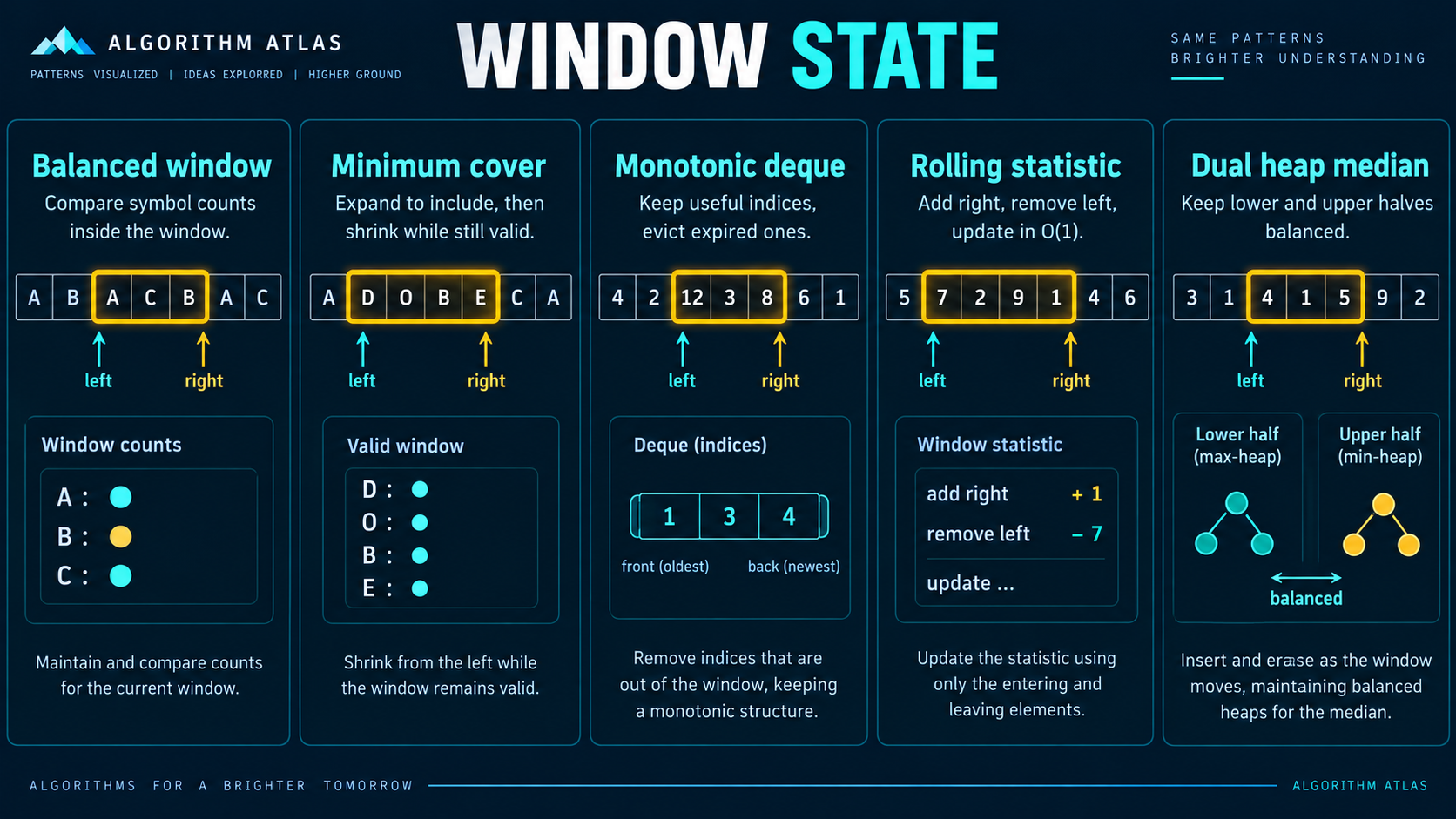
Keep candidate indexes in decreasing value order and evict those outside the window.
This call is starting. Local values appear as they are initialized.
Data & variables
Changed Source indexExample input
[1,3,-1,-3,5,3,6,7]Follow the code. Data appears here when it enters scope.
Call stack · 1 frame
maincall 1
Rust source
Line 27fn csv<T: std::fmt::Display>(a: impl IntoIterator<Item = T>) -> String {
a.into_iter()
.map(|x| x.to_string())
.collect::<Vec<_>>()
.join(",")
}
fn window_maxima(values: &[i32], k: usize) -> Vec<i32> {
assert!(k > 0 && k <= values.len());
let mut deque = std::collections::VecDeque::new();
let mut result = Vec::new();
for (i, &x) in values.iter().enumerate() {
while deque.front().is_some_and(|&j| j + k <= i) {
deque.pop_front();
}
while deque.back().is_some_and(|&j| values[j] <= x) {
deque.pop_back();
}
deque.push_back(i);
if i + 1 >= k {
result.push(values[*deque.front().unwrap()]);
}
}
result
}
fn main() {
let result = csv(window_maxima(&[1, 3, -1, -3, 5, 3, 6, 7], 3));
println!("{result}");
}
Try your own version
Compare the visible input `[1,3,-1,-3,5,3,6,7]` with `[3,3,3,3,3,3,3]`. Predict why their results are `3,3,5,5,6,7` and `3,3,3,3,3`. Then change one legal value and explain whether the same invariant, indexes tell when a candidate expires from the window, still applies.
Open personal copy in Playground ↗Start with this exact source and input, change a value, then use Run or Debug locally. This replay stays attached to the original example.
Recordings use a native Rust target. Playground runs on wasm32-wasip1; target-sized types such as usize can have different limits.
Understand it
For [1,3,-1,-3,5,3,6,7] and k=3, candidate 1 is dominated by 3 and removed. Later 5 dominates older smaller candidates. Expire indexes before i-k+1; the reported maxima are [3,3,5,5,6,7].
The worked program is a complete executable for this pattern. Its core function uses typed input so the state transitions remain visible. The challenge input contract is: Return maxima for every window of length three. The visible fixture is [1,3,-1,-3,5,3,6,7] and its example result is 3,3,5,5,6,7. The implementation and additional semantic fixtures were checked against an independent reference calculation. Those bounded tests establish these examples; they are not a proof for all inputs or a measurement on an iPhone.
Return a canonical String from solve: lowercase true/false for booleans; decimal integers without extra signs, leading zeros or whitespace; comma-separated sequence values and semicolon-separated groups. Whole-number medians have no decimal suffix; half medians use .5. Do not append a newline to the returned value. Preserve the explicitly named textual sentinels such as none or #. Input fixtures are bounded so the demonstrated arithmetic fits its named Rust types; satisfy the stated input preconditions before applying the algorithm.
String and character-grid fixtures use ASCII unless the lesson explicitly specifies Unicode scalar values.
A problem is a good match for Monotonic Deque Window when it asks for sliding maximum or minimum. Here the concrete task is: Return maxima for every window of length three. The visible input [1,3,-1,-3,5,3,6,7] is an example, not a definition of the whole problem. Ask what operations the solution must support and what the input guarantees. Choose this family when a valid window can be repaired by moving one boundary; non-monotone constraints may need a different method. The right choice follows from those guarantees, not from a familiar noun in the prompt.
The decisive invariant is: Keep candidate indexes in decreasing value order and evict those outside the window. Try to say why it applies to the task without quoting the implementation. Which fact becomes known after one update, and which possible answers remain? A window is a contiguous interval with a maintained summary. Describe what entering the right edge adds and what leaving the left edge removes. If that claim cannot be maintained on a legal input, the pattern is wrong or one of its preconditions is missing. A counterexample is more useful than a vague warning: change one property of the sample, trace the first two steps, and identify the exact claim that fails.
Compare costs before committing. The advertised bound is O(n) time · O(k) space; identify the operation responsible for it and the extra memory it needs. Then compare a straightforward alternative: a direct scan, full sort, or repeated recomputation may be easier but can pay for the same work many times. Do not choose the more elaborate method just because it has a famous name. For the sample, predict 3,3,5,5,6,7 and explain which part of the state lets the method reach that result.
When the prompt is ambiguous, ask about input size, ordering, duplicates, and required output format. Test an empty window, a window spanning the whole input, and a case where the left edge must advance several times. Represent bounds as a half-open range when possible. Keep counts and the window length in sync when shrinking it. The Rust sketch can show a useful primitive without proving that the whole task is solved; connect each primitive to the requested output. You should be able to name a fitting case, a near miss, and the assumption separating them before writing the first line.
The pattern
Keep candidate indexes in decreasing value order and evict those outside the window.
When to use it: sliding maximum or minimum
Complexity: O(n) time · O(k) space
Input: [1,3,-1,-3,5,3,6,7]
Read the code
fn csv<T: std::fmt::Display>(a: impl IntoIterator<Item = T>) -> String {
    a.into_iter()
        .map(|x| x.to_string())
        .collect::<Vec<_>>()
        .join(",")
}
fn window_maxima(values: &[i32], k: usize) -> Vec<i32> {
    assert!(k > 0 && k <= values.len());
    let mut deque = std::collections::VecDeque::new();
    let mut result = Vec::new();
    for (i, &x) in values.iter().enumerate() {
        while deque.front().is_some_and(|&j| j + k <= i) {
            deque.pop_front();
        }
        while deque.back().is_some_and(|&j| values[j] <= x) {
            deque.pop_back();
        }
        deque.push_back(i);
        if i + 1 >= k {
            result.push(values[*deque.front().unwrap()]);
        }
    }
    result
}

fn main() {
    let result = csv(window_maxima(&[1, 3, -1, -3, 5, 3, 6, 7], 3));
    println!("{result}");
}
Complete std-only monotonic-deque-window program for its typed teaching fixture. Parsing and output construction are separate from the core algorithm.
Try it
Compare the visible and independent fixtures. Explain the input assumption that makes this algorithm applicable, then identify a change that would invalidate it.
What success looks like: You can justify the choice from constraints rather than from a remembered problem title.
Check your understanding
Trace Monotonic Deque Window on input [1,2,3,4,5,6,7]. Which result follows from the documented contract?
Reveal the answer
4,5,6,73,4,5,6,74,4,5,6,7
For this input the result is 3,4,5,6,7. Indexes tell when a candidate expires from the window. Compare this independent fixture with the worked trace: For [1,3,-1,-3,5,3,6,7] and k=3, candidate 1 is dominated by 3 and removed. Later 5 dominates older smaller candidates. Expire indexes before i-k+1; the reported maxima are [3,3,5,5,6,7].
Go deeper
Common misconception: “A deque cannot store duplicate values”
Indexes tell when a candidate expires from the window. For [1,3,-1,-3,5,3,6,7] and k=3, candidate 1 is dominated by 3 and removed. Later 5 dominates older smaller candidates. Expire indexes before i-k+1; the reported maxima are [3,3,5,5,6,7].
- Concrete transition: For [1,3,-1,-3,5,3,6,7] and k=3, candidate 1 is dominated by 3 and removed. Later 5 dominates older smaller candidates. Expire indexes before i-k+1; the reported maxima are [3,3,5,5,6,7].
- Independent second fixture: Input
[1,2,3,4,5,6,7]produces3,4,5,6,7. Execute the named function in the worked program with these typed arguments, then compare its actual result with this independently computed expectation. - Boundary and contract: Input
[8,7,6,5,4,3,2]produces8,7,6,5,4. Indexes tell when a candidate expires from the window. The stated work bound is O(n) time · O(k) space. Count actual state changes; a successful output test alone does not prove that bound.
Transfer challenge: Compare the visible input [1,3,-1,-3,5,3,6,7] with [3,3,3,3,3,3,3]. Predict why their results are 3,3,5,5,6,7 and 3,3,3,3,3. Then change one legal value and explain whether the same invariant, indexes tell when a candidate expires from the window, still applies.
Connections
- Monotonic Deque Window: Mental Model: Keep candidate indexes in decreasing value order and evict those outside the window.
- Challenge: Monotonic Deque Window: Return maxima for every window of length three.
Reveal the Algorithm Atlas answer
3,3,5,5,6,7
Learn this lesson with AI
Paste this into Claude, Codex, Cursor or another agent connected to Crabrix Academy. It contains only this lesson’s public details.
I'm learning Rust with Crabrix Academy. Teach me this lesson with the Crabrix Academy tools.
Lesson: Monotonic Deque Window: When to Use It (courseId "algorithms", lessonId "algorithm.monotonic-deque-window.recognize")
Link: https://crabrix.com/learn/algorithms/algorithm.monotonic-deque-window.recognize
Goal: Indexes tell when a candidate expires from the window. State the input preconditions before applying this invariant.
Practice: open the starter in the Crabrix Playground (https://crabrix.com/playground/?lesson=algorithms/algorithm.monotonic-deque-window.recognize) and I will write the code there.
Explain it step by step for my level, let me write the code myself, give hints before any solution, and do not mark anything as passed: only Crabrix checks do that.