
Algorithm Atlas · worked example
See the algorithm, step by step
Count valid one-symbol and two-symbol predecessors while rejecting leading zero states.
This call is starting. Local values appear as they are initialized.
Data & variables
Changed Source indexExample input
06Follow the code. Data appears here when it enters scope.
Call stack · 1 frame
maincall 1
Rust source
Line 17fn decodings(text: &str) -> u64 {
assert!(text.bytes().all(|c| c.is_ascii_digit()));
let a = text.as_bytes();
let (mut before, mut current) = (1, 1);
for i in 0..a.len() {
let mut next = if a[i] != b'0' { current } else { 0 };
if i > 0 && (a[i - 1] == b'1' || a[i - 1] == b'2' && a[i] <= b'6') {
next += before;
}
before = current;
current = next;
}
current
}
fn main() {
let result = decodings("06").to_string();
println!("{result}");
}
Try your own version
Change the independent fixture `06` in a legal way, then compare the result with your prediction. Explain how the same invariant applies to the separate visible challenge `226`.
Open personal copy in Playground ↗Start with this exact source and input, change a value, then use Run or Debug locally. This replay stays attached to the original example.
Recordings use a native Rust target. Playground runs on wasm32-wasip1; target-sized types such as usize can have different limits.
Understand it
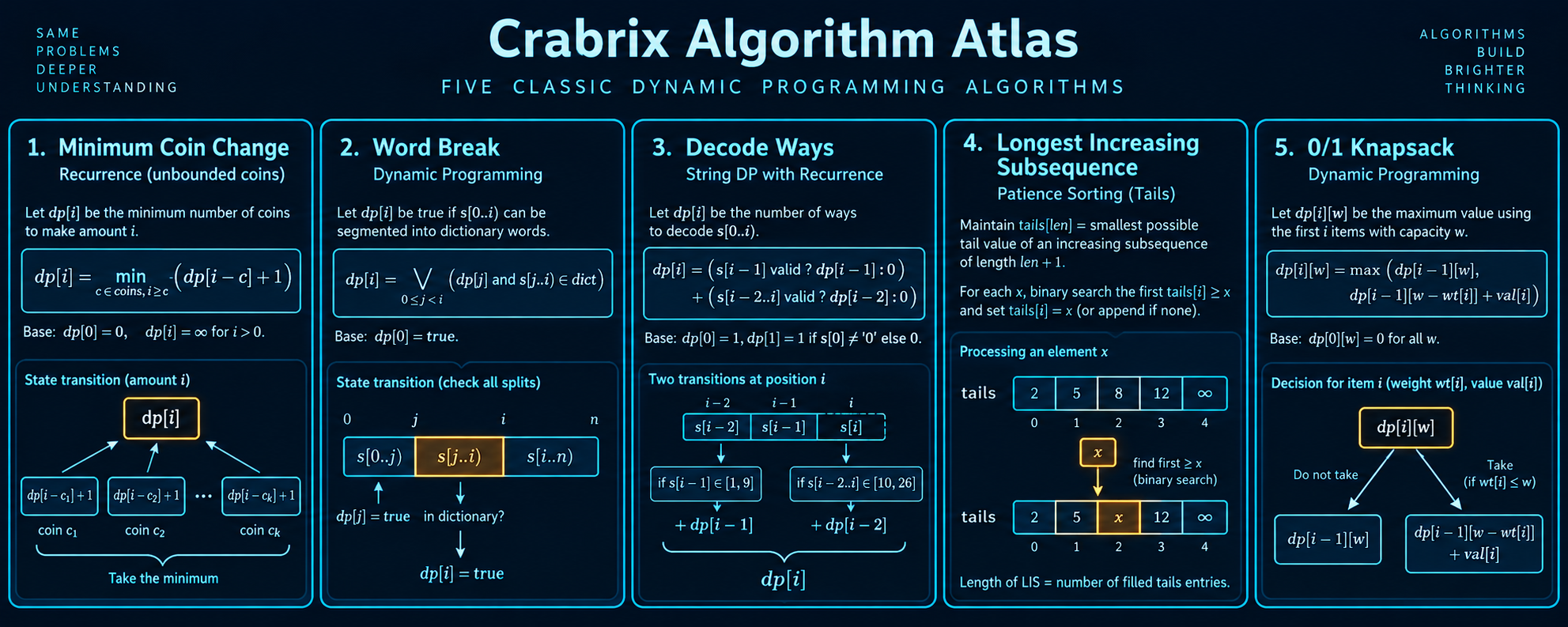
Valid letter codes are 1 through 26. The worked program demonstrates this invariant on an independent fixture, so you can study the implementation before predicting the challenge result.
For teaching input 06, the worked program returns 0. Its functions are complete and use only std. Adapt the same state transitions to the visible challenge input 226; predict that result before opening the answer reveal. The precise contract is: Return the number of valid A=1 through Z=26 decodings.
Return canonical output: lowercase booleans, decimal integers without leading zeros, comma-separated values and semicolon-separated groups, with no extra whitespace or final newline. Whole medians use integer form and half medians use .5. Textual sentinels such as none and # retain their stated meaning. String and character-grid fixtures use ASCII unless the lesson explicitly specifies Unicode scalar values.
Solve the exact task, not just the visible example: Return the number of valid A=1 through Z=26 decodings. On input 226, predict the output before opening the answer reveal. The revealed output is a test oracle for this case, while private checks exercise other legal cases. Start by stating the input grammar and output format in your own words. Parse the complete input, including surrounding whitespace, before relying on any convenient positions in the example.
Build the solution around one maintained claim: Count valid one-symbol and two-symbol predecessors while rejecting leading zero states. Decide what state represents that claim, how it is initialized, what a single update does, and when the algorithm stops. A one-dimensional DP state summarizes a prefix or a single parameter. Define its meaning before writing a recurrence. Trace the visible input by hand and record at least two intermediate states, not only the final answer. If the trace cannot justify your predicted output, there is a gap between the idea and the implementation.
Check both correctness and cost. The intended bound is O(n) time · O(1) space; explain which operation dominates it and how many times the input can trigger that operation. Test the base state, the first transition, impossible states, and whether an in-place update accidentally reuses an item twice. Add one small case that should succeed, one boundary case, and one case chosen to challenge the invariant. Compare your hand result with the program's result, then use a failing case to fix the earliest incorrect state transition rather than patching the final output.
The pattern
Count valid one-symbol and two-symbol predecessors while rejecting leading zero states.
When to use it: encoded strings with local validity rules
Complexity: O(n) time · O(1) space
Input: 226
Read the code
fn decodings(text: &str) -> u64 {
    assert!(text.bytes().all(|c| c.is_ascii_digit()));
    let a = text.as_bytes();
    let (mut before, mut current) = (1, 1);
    for i in 0..a.len() {
        let mut next = if a[i] != b'0' { current } else { 0 };
        if i > 0 && (a[i - 1] == b'1' || a[i - 1] == b'2' && a[i] <= b'6') {
            next += before;
        }
        before = current;
        current = next;
    }
    current
}

fn main() {
    let result = decodings("06").to_string();
    println!("{result}");
}
Complete std-only decode-ways program for its typed teaching fixture. Parsing and output construction are separate from the core algorithm.
Practice starter
pub fn solve(input: &str) -> String {
    // Return the number of valid A=1 through Z=26 decodings.
    // Trim surrounding whitespace; implement parsing and the algorithm.
    let _ = input;
    todo!("implement decode-ways")
}
Try it
Return the number of valid A=1 through Z=26 decodings.
What success looks like: The private harness prints PASS decode-ways. It checks at least five distinct semantic inputs plus surrounding-whitespace variants. Explain complexity separately; this harness does not time the algorithm.
Check your understanding
Boundary check for decode-ways: with input 1111, what result should solve return?
Reveal the answer
564
For this input the result is 5. Valid letter codes are 1 through 26. Compare this independent fixture with the worked trace: String 226 splits as 2-2-6,22-6,2-26, giving 3. String 06 begins with an invalid zero and gives 0. String 10 is valid only as the two-digit code 10, so it has one decoding.
Go deeper
Common misconception: “Zero always means an extra optional letter”
Valid letter codes are 1 through 26. The independent teaching fixture demonstrates this rule; predict the separate visible challenge before revealing its answer.
- Pattern-specific invariant: Valid letter codes are 1 through 26. This is the property the named implementation maintains; explain which comparison, state update or recursive return in the worked program establishes it.
- Independent typed fixture: The worked call uses
06and computes0. Keep parsing separate, then identify the core state before and after this call. - Different legal case: For
1111, the independently calculated result is5. The complexity discussion uses O(n) time · O(1) space. Verify the state invariant before reasoning about the operation count.
Transfer challenge: Change the independent fixture 06 in a legal way, then compare the result with your prediction. Explain how the same invariant applies to the separate visible challenge 226.
Connections
- Decode Ways DP: When to Use It: encoded strings with local validity rules
- Longest Increasing Subsequence: Mental Model: Keep the smallest possible tail for an increasing subsequence of every length.
Reveal the Algorithm Atlas answer
3
Learn this lesson with AI
Paste this into Claude, Codex, Cursor or another agent connected to Crabrix Academy. It contains only this lesson’s public details.
I'm learning Rust with Crabrix Academy. Teach me this lesson with the Crabrix Academy tools.
Lesson: Challenge: Decode Ways DP (courseId "algorithms", lessonId "algorithm.decode-ways.challenge")
Link: https://crabrix.com/learn/algorithms/algorithm.decode-ways.challenge
Goal: Valid letter codes are 1 through 26. Return the number of valid A=1 through Z=26 decodings.
Practice: open the starter in the Crabrix Playground (https://crabrix.com/playground/?lesson=algorithms/algorithm.decode-ways.challenge) and I will write the code there.
Explain it step by step for my level, let me write the code myself, give hints before any solution, and do not mark anything as passed: only Crabrix checks do that.