

Algorithm Atlas · worked example
See the algorithm, step by step
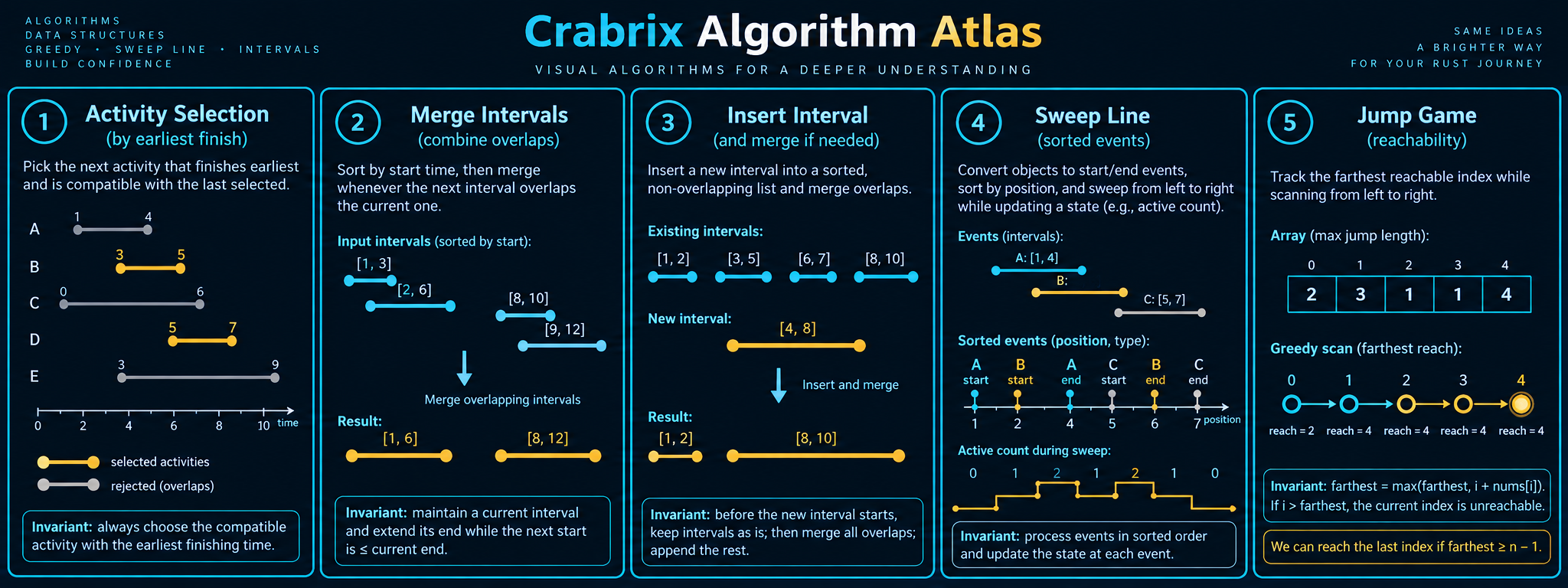
Choose the compatible interval that finishes earliest, leaving maximum room for the future.
This call is starting. Local values appear as they are initialized.
Data & variables
Changed Source indexExample input
[(1,2),(3,4),(0,6),(5,7),(8,9),(5,9)]Follow the code. Data appears here when it enters scope.
Call stack · 1 frame
maincall 1
Rust source
Line 16fn maximum_meetings(intervals: &[(i32, i32)]) -> usize {
let mut sorted = intervals.to_vec();
sorted.sort_by_key(|&(s, e)| (e, s));
let mut end = i32::MIN;
let mut kept = 0;
for (s, e) in sorted {
if s >= end {
kept += 1;
end = e;
}
}
kept
}
fn main() {
let result = maximum_meetings(&[(1, 2), (3, 4), (0, 6), (5, 7), (8, 9), (5, 9)]).to_string();
println!("{result}");
}
Try your own version
Compare the visible input `[(1,2),(3,4),(0,6),(5,7),(8,9),(5,9)]` with `[(0,5),(1,3),(3,4)]`. Predict why their results are `4` and `2`. Then change one legal value and explain whether the same invariant, it leaves the most remaining time without reducing achievable count, still applies.
Open personal copy in Playground ↗Start with this exact source and input, change a value, then use Run or Debug locally. This replay stays attached to the original example.
Recordings use a native Rust target. Playground runs on wasm32-wasip1; target-sized types such as usize can have different limits.
Understand it
Sort the six sample meetings by finish time. Keeping (1,2),(3,4),(5,7),(8,9) yields count 4. Touching endpoints are compatible under the half-open convention, so [(1,2),(2,3)] yields 2.
The worked program is a complete executable for this pattern. Its core function uses typed input so the state transitions remain visible. The challenge input contract is: The meetings may arrive in any order, and one ending at t is compatible with one starting at t. Return the maximum number of compatible meetings. The visible fixture is [(1,2),(3,4),(0,6),(5,7),(8,9),(5,9)] and its example result is 4. The implementation and additional semantic fixtures were checked against an independent reference calculation. Those bounded tests establish these examples; they are not a proof for all inputs or a measurement on an iPhone.
Return a canonical String from solve: lowercase true/false for booleans; decimal integers without extra signs, leading zeros or whitespace; comma-separated sequence values and semicolon-separated groups. Whole-number medians have no decimal suffix; half medians use .5. Do not append a newline to the returned value. Preserve the explicitly named textual sentinels such as none or #. Input fixtures are bounded so the demonstrated arithmetic fits its named Rust types; satisfy the stated input preconditions before applying the algorithm.
String and character-grid fixtures use ASCII unless the lesson explicitly specifies Unicode scalar values.
A problem is a good match for Activity Selection when it asks for maximum count of non-overlapping jobs. Here the concrete task is: The meetings may arrive in any order, and one ending at t is compatible with one starting at t. Return the maximum number of compatible meetings. The visible input [(1,2),(3,4),(0,6),(5,7),(8,9),(5,9)] is an example, not a definition of the whole problem. Ask what operations the solution must support and what the input guarantees. When the method sorts intervals or events, use the coordinate and tie break required by its proof. Other greedy walks keep an invariant without sorting. The right choice follows from those guarantees, not from a familiar noun in the prompt.
The decisive invariant is: Choose the compatible interval that finishes earliest, leaving maximum room for the future. Try to say why it applies to the task without quoting the implementation. Which fact becomes known after one update, and which possible answers remain? A greedy step commits to a local choice. Give the exchange or dominance reason that an optimal solution can still include that choice. If that claim cannot be maintained on a legal input, the pattern is wrong or one of its preconditions is missing. A counterexample is more useful than a vague warning: change one property of the sample, trace the first two steps, and identify the exact claim that fails.
Compare costs before committing. The advertised bound is O(n log n) time · O(n) owned sorted copy; O(1) greedy state; identify the operation responsible for it and the extra memory it needs. Then compare a straightforward alternative: a direct scan, full sort, or repeated recomputation may be easier but can pay for the same work many times. Do not choose the more elaborate method just because it has a famous name. For the sample, predict 4 and explain which part of the state lets the method reach that result.
When the prompt is ambiguous, ask about input size, ordering, duplicates, and required output format. Test touching intervals, equal endpoints, empty input, and a locally attractive choice that blocks a better future choice. Keep interval endpoint conventions explicit where they apply. If sorting is part of the method, its Rust comparator must encode the proof's exact tie break. The Rust sketch can show a useful primitive without proving that the whole task is solved; connect each primitive to the requested output. You should be able to name a fitting case, a near miss, and the assumption separating them before writing the first line.
The pattern
Choose the compatible interval that finishes earliest, leaving maximum room for the future.
When to use it: maximum count of non-overlapping jobs
Complexity: O(n log n) time · O(n) owned sorted copy; O(1) greedy state
Input: [(1,2),(3,4),(0,6),(5,7),(8,9),(5,9)]
Read the code
fn maximum_meetings(intervals: &[(i32, i32)]) -> usize {
    let mut sorted = intervals.to_vec();
    sorted.sort_by_key(|&(s, e)| (e, s));
    let mut end = i32::MIN;
    let mut kept = 0;
    for (s, e) in sorted {
        if s >= end {
            kept += 1;
            end = e;
        }
    }
    kept
}

fn main() {
    let result = maximum_meetings(&[(1, 2), (3, 4), (0, 6), (5, 7), (8, 9), (5, 9)]).to_string();
    println!("{result}");
}
Complete std-only activity-selection program for its typed teaching fixture. Parsing and output construction are separate from the core algorithm.
Try it
Compare the visible and independent fixtures. Explain the input assumption that makes this algorithm applicable, then identify a change that would invalidate it.
What success looks like: You can justify the choice from constraints rather than from a remembered problem title.
Check your understanding
Trace Activity Selection on input [(0,1),(1,2),(2,3)]. Which result follows from the documented contract?
Reveal the answer
432
For this input the result is 3. It leaves the most remaining time without reducing achievable count. Compare this independent fixture with the worked trace: Sort the six sample meetings by finish time. Keeping (1,2),(3,4),(5,7),(8,9) yields count 4. Touching endpoints are compatible under the half-open convention, so [(1,2),(2,3)] yields 2.
Go deeper
Common misconception: “The longest interval always leaves the most choices”
It leaves the most remaining time without reducing achievable count. Sort the six sample meetings by finish time. Keeping (1,2),(3,4),(5,7),(8,9) yields count 4. Touching endpoints are compatible under the half-open convention, so [(1,2),(2,3)] yields 2.
- Concrete transition: Sort the six sample meetings by finish time. Keeping (1,2),(3,4),(5,7),(8,9) yields count 4. Touching endpoints are compatible under the half-open convention, so [(1,2),(2,3)] yields 2.
- Independent second fixture: Input
[(0,1),(1,2),(2,3)]produces3. Execute the named function in the worked program with these typed arguments, then compare its actual result with this independently computed expectation. - Boundary and contract: Input
[(1,4),(2,5)]produces1. It leaves the most remaining time without reducing achievable count. The stated work bound is O(n log n) time · O(n) owned sorted copy; O(1) greedy state. Count actual state changes; a successful output test alone does not prove that bound.
Transfer challenge: Compare the visible input [(1,2),(3,4),(0,6),(5,7),(8,9),(5,9)] with [(0,5),(1,3),(3,4)]. Predict why their results are 4 and 2. Then change one legal value and explain whether the same invariant, it leaves the most remaining time without reducing achievable count, still applies.
Connections
- Activity Selection: Mental Model: Choose the compatible interval that finishes earliest, leaving maximum room for the future.
- Challenge: Activity Selection: The meetings may arrive in any order, and one ending at t is compatible with one starting at t. Return the maximum number of compatible meetings.
Reveal the Algorithm Atlas answer
4
Learn this lesson with AI
Paste this into Claude, Codex, Cursor or another agent connected to Crabrix Academy. It contains only this lesson’s public details.
I'm learning Rust with Crabrix Academy. Teach me this lesson with the Crabrix Academy tools.
Lesson: Activity Selection: When to Use It (courseId "algorithms", lessonId "algorithm.activity-selection.recognize")
Link: https://crabrix.com/learn/algorithms/algorithm.activity-selection.recognize
Goal: It leaves the most remaining time without reducing achievable count. State the input preconditions before applying this invariant.
Practice: open the starter in the Crabrix Playground (https://crabrix.com/playground/?lesson=algorithms/algorithm.activity-selection.recognize) and I will write the code there.
Explain it step by step for my level, let me write the code myself, give hints before any solution, and do not mark anything as passed: only Crabrix checks do that.